

























































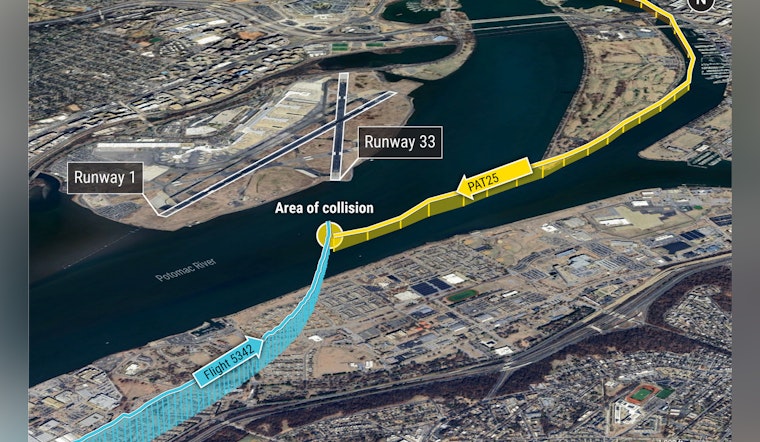
Federal investigators say a chain of systemic failures in airspace design, oversight, and air-traffic procedures combined to cause the Jan. 29, 2025, midair collision over the Potomac River that killed 67 people. The National Transportation Safety Board adopted its formal findings this week after a yearlong probe into the crash near Ronald Reagan Washington National Airport, faulting the FAA, the U.S. Army, and local tower practices while calling for sweeping safety fixes.
At a public meeting, the NTSB voted to approve 74 findings and 50 recommendations that place primary blame on flawed helicopter route design, insufficient oversight, and gaps in military flight safety, according to an NTSB report. Investigators concluded the collision happened when American Airlines Flight 5342, a CRJ700 operated by PSA Airlines, and a U.S. Army UH-60 Black Hawk made contact about a half-mile southeast of the runway. All 64 people on the jet and the three helicopter crewmembers were killed. As part of a wide-ranging safety push, the board issued 33 recommendations to the FAA and eight to the Army.
“This complex and comprehensive one-year investigation identified serious and long-standing safety gaps in the airspace over our nation’s capital,” NTSB Chair Jennifer Homendy said in remarks published by the NTSB. Homendy added that the conditions for the disaster “were in place long before the night of Jan. 29,” and said the board will press regulators and military leaders to act on its recommendations.
What investigators found
Investigators determined that a helicopter route along the Potomac let rotorcraft fly immediately beneath active approach corridors for airliners, creating dangerously thin vertical separation that regulators had not properly analyzed, according to reporting by The Associated Press. The board also documented years of near-misses that controllers had logged but that did not trigger sufficient corrective action.
The NTSB also pointed to air-traffic procedures and communication breakdowns. High controller workload on the night of the crash cut into situational awareness, and the use of separate radio frequencies for helicopters and airplanes made it more likely that critical transmissions would be missed or blocked, Axios reported. According to the board, those operational gaps, combined with equipment issues and human limits, created a cascading risk that turned deadly.
Why ADS-B and other tech mattered
The board singled out collision-avoidance and surveillance technology as one of the quickest fixes on the table. Investigators said that if the arriving airliner had been equipped to receive ADS-B In traffic data, it could have alerted the crew roughly a minute before impact, potentially giving them time to avoid the crash, The Associated Press reported. The report also notes that the helicopter’s location-broadcasting system either was not functioning or was not turned on that night.
In the wake of the collision, the FAA moved quickly to restrict non-essential helicopter flights along the Potomac and to require aircraft using the corridor to broadcast ADS-B Out signals, the FAA said in a statement. On Capitol Hill, the Senate unanimously approved the bipartisan ROTOR Act, a measure that would require ADS-B In and Out capability in congested airspace and close military exemptions, and lawmakers are pressing the House to follow suit, according to the Senate Commerce Committee.
Victims' families and several members of Congress told the NTSB and congressional committees this month that the crash was preventable and urged faster, mandatory upgrades to systems and procedures, The Washington Post reported. Some relatives have also called for more Army transparency and independent oversight of military flights that use civilian corridors as part of any policy response.
The NTSB can only issue safety recommendations and has no authority to enforce them, leaving it an open question whether the FAA, the military or Congress will move quickly enough to close the gaps, Axios noted. The board says it will keep pushing for reforms while the agency prepares a full final report in the coming weeks. Local outlets, including WFAA, have been breaking down the key findings for residents and travelers who pass through the region’s crowded airspace.





