

























































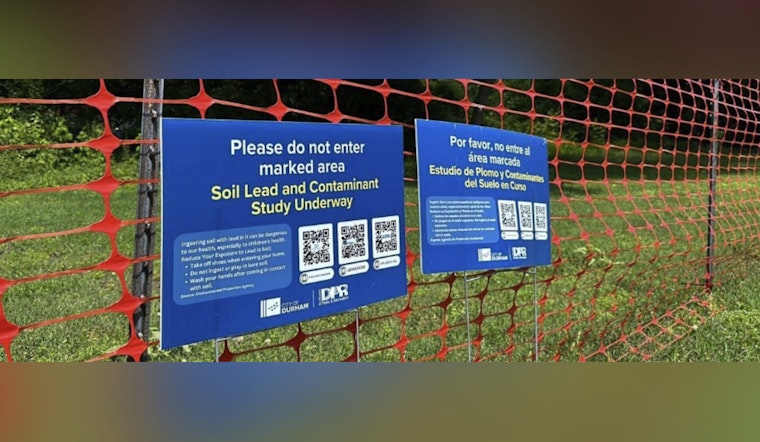
Across East Durham, the sight of orange mesh and locked gates has become a frustrating backdrop to childhood. Playgrounds and soccer fields remain off limits after soil tests turned up lead, leaving families, schools and youth programs scrambling for somewhere nearby for kids to run around. Two of the five affected city parks sit inside East Durham neighborhoods, and organizers say summer programs and casual pickup games have fallen off sharply. At Burton Park, a fenced off creek cuts below a relatively new playground, after testing tied contamination along the waterway to nearby industrial activity. Residents and small business owners say the gap between testing and actual cleanup is now stretching into a second year with no reliable outdoor space for children.
State steps in, cleanup plans still pending
The city has closed off portions of Walltown, Lyon, Northgate, East Durham and East End parks after screening found elevated lead in the soil, and Durham Parks & Recreation says state contractors are now handling a deeper assessment, according to Durham Parks & Recreation. The North Carolina Department of Environmental Quality’s Pre-Regulatory Landfill Program is preparing remedial investigation summaries and risk-based action plans that will determine whether the sites get excavation work, engineered soil covers or land-use restrictions, per NC DEQ.
No safe sidelines for kids
Local leaders say the closures are squeezing an already thin network of parks and youth programs. "There is no public place to play," bike-program leader Ashley Scott told WUNC, pointing to fenced playgrounds and fields that once served nearby schools and housing complexes. Recreation Advisory Commission member Gregory Williams has argued that layers of feasibility studies and interagency reviews are slowing obvious fixes, and Durham Parks director Wade Walcutt told the station that "we hope to get all the summary reports by March."
Old incinerators and stricter standards
Duke researchers first flagged abnormal lead levels in park soils in 2022, a finding that triggered follow up sampling and broader public scrutiny, as reported by The Duke Chronicle. City officials say at least some of the contamination traces back to mid-20th century trash incinerators that once operated on or near several park sites. On top of that, tighter EPA screening guidance and expanded 2024 sampling increased the number of fenced-off "hotspots," as reflected in testing updates from Durham Parks & Recreation.
Neighbors test their yards and organizers step up
With public parks blocked, some residents have turned their attention to the soil right outside their doors. Toxic Free NC and other nonprofits have run neighborhood soil-testing workshops where people can drop off samples for rapid screening, and community sessions have offered on-the-spot XRF readings and basic lead education, according to Toxic Free NC. Local reporting describes city-partnered events that provided quick results and blood-lead information during recent drop-off sessions, per 9th Street Journal.
Regulatory fallout and a nearby chemical plant
At Burton Park, the creek closure is tied to problems upstream. The waterway was linked to an illegal discharge, and testing on the nearby Brenntag property found high levels of toluene, ethanol and acetone at the property boundary, which prompted a city water-quality notice, according to the City of Durham. At the state level, NC DEQ’s Pre-Regulatory Landfill Unit oversees the technical reviews and can make sites eligible for state reimbursement or prioritized cleanup under its rules, per NC DEQ.
What comes next
City leaders have floated using local dollars to jump-start remediation while state work continues, including a 2024 budget presentation that recommended roughly $5 million to begin cleanup, according to earlier reporting by WUNC. Neighbors say they also need clearer short-term play options while the technical work drags on. For now, parents, organizers and small businesses say they plan to keep pressing for interim programming and faster timelines as DEQ finishes its summary reports this spring.



