

























































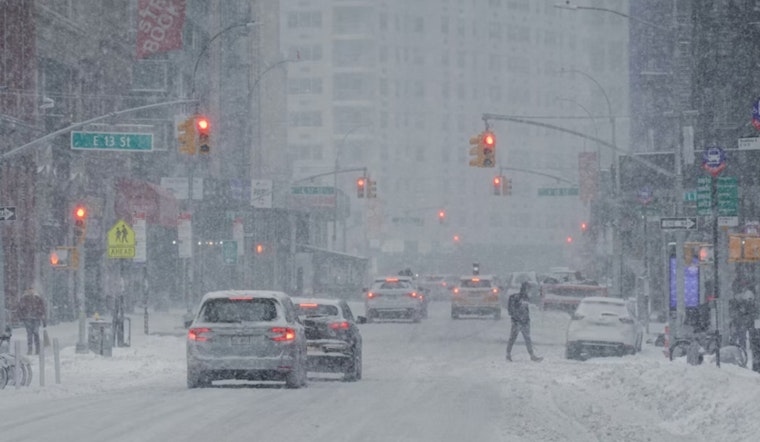
That gray, trash-studded snowbank on the corner is not just an eyesore. It is a chemistry project waiting to go wrong.
Gothamist recently scooped up samples from some of New York’s nastiest sidewalk snow piles in Williamsburg, Washington Heights and under the elevated 7 train in Jackson Heights. Lab tests found those filthy mounds are acting like little contamination traps, concentrating road salt chemicals, elevated lead and fecal-associated bacteria.
What the tests found
Lab analysis of the three neighborhood samples turned up lead levels of 279 parts per billion in the Jackson Heights pile, 125 ppb in a Williamsburg pile and 113 ppb in Washington Heights. The Jackson Heights sample also clocked the highest concentration of Enterococcus, a fecal-associated bacteria, as reported by Gothamist.
Jack Caravanos, an environmental public health professor, put it in kid-level terms. “A kid is skimming some snow and putting it in their mouth, they would get a decent dose of lead,” he warned.
For comparison, the EPA’s Lead and Copper Rule uses 15 parts per billion as the action level for lead in drinking water, a standard often used to frame how serious contamination numbers are, according to the U.S. Environmental Protection Agency.
City salt and melting operations
All that gunk does not appear out of nowhere. The mayor’s office says the city spread roughly 116 million pounds of road salt during the recent cold spell and has been running snow-melting sites that processed millions of pounds of snow as crews hustled to clear crosswalks, bus stops and hydrants. Those figures come from an operations update by the Mayor’s Office.
Salt, aerosols and stormwater
The lab work also flagged high levels of calcium and sodium, the basic chemistry of de-icing mixes. Columbia geochemist Steven Chillrud told reporters that when the city lays down heavy salt and then temperatures stay low, that can create an aerosolized salty mist that irritates the eyes, as described in reporting.
Eventually the piles melt, and much of that dirty water runs straight into New York’s sewer network. In areas with combined sewers, stormwater can overwhelm treatment plants so that the excess is discharged into local waterways, according to the New York State Department of Environmental Conservation and reporting in the local press.
Risk and context
Scientists stress that what shows up in melted sidewalk snow is not the same as what comes out of your tap, and the numbers should not be confused with city drinking water readings. They also note that legacy soil contamination on some blocks can be much higher, a reminder that lead exposure in a big city has plenty of sources.
Peer-reviewed research and doctoral work have documented elevated lead in portions of New York City soil, reflecting decades of old paint, industry and traffic pollution. See scholarly work on NYC soils for background.
Public health authorities repeatedly point out that there is no safe blood lead level for children and advise limiting hand-to-mouth contact and getting medical testing if exposure is suspected, according to the CDC.
Practical takeaway: do not let kids eat or “taste test” sidewalk snow, have everyone wash hands after playing outside and talk with a pediatrician about lead testing if you think a child might have been exposed. Those grimy neighborhood piles are a winter reminder that whatever the city, and its residents, leave on the streets tends to end up right there in the slush.




