

























































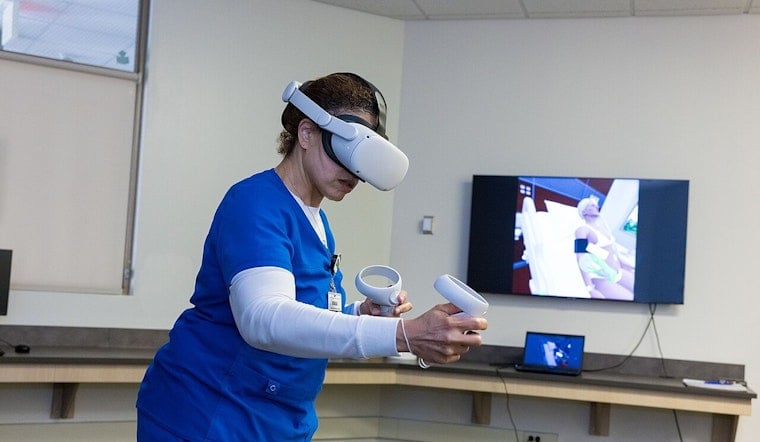
In Charlotte, a team of surgeons at OrthoCarolina is betting virtual reality can do more than distract patients. They say it may be able to shut down phantom limb pain before it ever settles in as a chronic problem. Their startup, Axolo Health, has turned that idea into a hands-free, gaze-controlled program called Targeted Brain Rehabilitation that clinicians are beginning to use in clinic settings. Early patient tests and company data are encouraging enough that local hospitals and prosthetics teams are taking a closer look.
FDA registration clears the way for clinic use
According to a release on PRWeb, the U.S. Food and Drug Administration has registered Axolo Health’s Targeted Brain Rehabilitation platform as a Class II Software as a Medical Device under product code QKC (21 CFR 890.5360). The company says the registration, completed in December 2025, allows the therapy to be delivered as a prescription-use immersive system in clinic environments.
Built at OrthoCarolina’s limb-loss center
The program traces back to work by Drs. Glenn Gaston and Bryan Loeffler at OrthoCarolina’s Reconstructive Center for Lost Limbs, where surgeons combined new operative techniques with rehabilitation and virtual reality to help amputees regain function. As outlined by OrthoCarolina, those clinical protocols and early VR trials directly shaped the company’s eventual strategy.
Local patient tests show surprising promise
As reported by Charlotte Business Journal, an OrthoCarolina patient has already used the therapeutic VR device, and clinicians say early evidence suggests it may prevent phantom limb pain rather than only dial down symptoms after they appear. The local coverage pushed the work into broader view, and clinicians stress that larger, controlled trials will be needed before anyone declares victory.
How the therapy retrains the brain
According to Axolo Health, Targeted Brain Rehabilitation is a structured, four-phase neurorehabilitation program that moves patients through laterality recognition, guided motor imagery, immersive mirror therapy and motor execution. It is delivered through hands-free, gaze-controlled XR headsets meant to help rebuild disrupted neural maps. Axolo’s media materials and feasibility work describe the usability studies and clinical design behind the platform, and the company says the system is built to be repeatable and folded into standard rehab workflows (Axolo Health).
Availability and implications for patients
Per the company’s release on PRWeb, Axolo says the therapy is now commercially available for in-clinic use, a step that could speed adoption at specialized limb-loss centers in Charlotte and beyond. Clinicians say a scalable, non-opioid approach that targets brain circuitry could help more amputees sleep better, use prosthetics more comfortably and get back to daily life sooner, if larger studies back up the early results.
Physicians also note that phantom limb pain has been stubbornly difficult to eliminate in past research. Even so, the surgeon-led design, early clinical use and FDA registration mean Charlotte’s limb-loss clinics may be among the first places to see whether this VR approach can progress from promising pilot to standard practice. Observers will be watching for the peer-reviewed studies and larger trials that could confirm or challenge the initial findings.




