

























































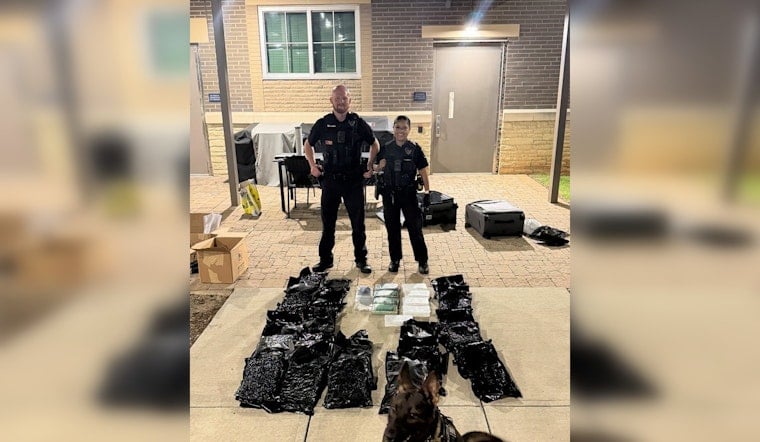
A person who bought a storage unit at auction in East Charlotte got an unwelcome surprise this week: packaged drugs stashed among the unit's contents. Officers who responded ended up seizing almost 25 pounds of suspected cocaine, more than 3 ounces of suspected methamphetamine, and about 0.89 ounces of suspected fentanyl from the unit.
According to the Charlotte-Mecklenburg Police Department, officers with the department's Hickory Grove Division responded to a found property call for service after the buyer reported purchasing the unit and discovering what appeared to be packaged narcotics among the items inside. The department says its investigation was assisted by the Mint Hill Police Department, and that the two agencies collaborated to keep the drugs off the street.
The Hickory Grove Division covers East Charlotte along the Albemarle Road corridor, an area that borders the jurisdiction of the neighboring Mint Hill Police Department, according to City of Charlotte mapping data. That shared boundary is part of why the two departments frequently coordinate on cases that straddle the line between city and town limits.
How North Carolina Law Treats the Seized Weights
The quantities described by CMPD fall well beyond the thresholds that trigger North Carolina's mandatory drug trafficking sentences. Under state law, trafficking charges are triggered by drug weight alone, regardless of whether prosecutors can show intent to sell, and convictions carry mandatory minimum active prison sentences, per the Ryan Willis Law PLLC firm's overview of the statute.
Possessing 28 or more grams of fentanyl in North Carolina is a Class C felony trafficking offense carrying a mandatory minimum of 225 months — nearly 19 years — in prison and a $1,000,000 fine, the same legal analysis notes. The roughly 25.2 grams described in the Hickory Grove case sits just under that specific threshold, though the cocaine and methamphetamine amounts recovered are far more severe under the statute.
Trafficking 400 grams or more of cocaine carries a mandatory minimum of 175 months in prison and a $250,000 fine under N.C. Gen. Stat. § 90-95(h). The nearly 25 pounds — about 11.3 kilograms — found in the unit exceeds that statutory maximum threshold by more than 28 times, according to Ryan Willis Law PLLC's breakdown of the tiered penalty structure.
The Legal Path From Storage Auction to Police Evidence
Storage facility auctions like the one that led to this discovery are governed by North Carolina's Self-Service Storage Facility Act. The law allows operators to sell delinquent tenants' property at public auction to recover unpaid rent, but it also requires good-faith buyers who stumble onto contraband to hand it over to law enforcement, per Justia Law's summary of the statute.
Separately, North Carolina's definition of drug manufacturing under state law extends to packaging or repackaging controlled substances, a provision that could allow investigators to pursue felony charges against whoever used the unit to stash the drugs before defaulting on the lease, according to legal analysis published by the Carolina Attorneys firm. It remains unknown who the previous leaseholder was, how long the drugs sat in the unit before the auction, or whether CMPD or a federal agency will ultimately handle any resulting prosecution.
This is not the first time a storage auction buyer has stumbled into a major narcotics stash. In a similar case in November, an auction purchaser in Douglas County, Colorado, reported finding illegal drugs in a unit, a discovery that led to that state's largest-ever fentanyl seizure, with nearly 200 kilograms of fentanyl and 2.5 pounds of methamphetamine recovered.
A Bust That Lands Amid a Persistent Overdose Crisis
The East Charlotte seizure comes as Mecklenburg County continues to grapple with high overdose mortality. The county recorded 356 drug overdose deaths in 2023 and more than 270 in 2024, driven largely by illicit fentanyl and polysubstance mixtures that combine opioids with cocaine and methamphetamine, according to data compiled by the Harmony Recovery Center.
Statewide, an estimated 2,731 North Carolina residents died from drug overdoses in 2025, averaging roughly eight fatal overdoses per day, per surveillance data from the North Carolina Department of Health and Human Services. Mecklenburg County began receiving payments in 2025 from a $75 million, 18-year national opioid settlement fund intended to support local addiction treatment, harm reduction programs, and emergency response infrastructure, as reported by WFAE 90.7.





