

























































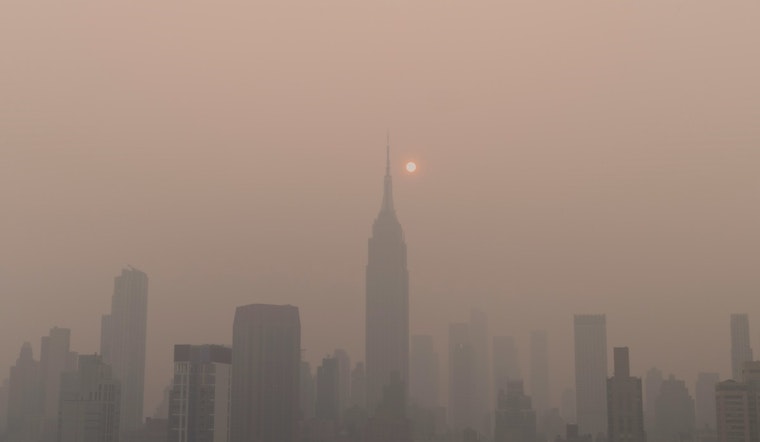
Hell's Kitchen neighbors say they are still breathing some of Manhattan's dirtiest air, especially along the clogged routes feeding the Port Authority and the Lincoln Tunnel. Street-level sensors and on-the-ground reporting show fine particulate pollution (PM2.5) clustering on the busiest avenues and around distribution hubs. For people who live and work there, that translates into more bad-air days and long-term health worries.
Local coverage has not been shy about pointing a finger at traffic, delivery vans and a wall-to-wall restaurant scene. In reporting for W42ST, writer Catie Savage notes that bus and truck congestion helps trap pollution in Hell's Kitchen's narrow corridors, with frequent PM2.5 spikes along sidewalks and crosswalks. Her piece follows residents and community advocates who say the problem has dragged on despite broader citywide cleanup efforts.
What City Monitoring Shows
The city's New York City Community Air Survey (NYCCAS) backs up what locals are seeing. The program finds that PM2.5 and other traffic-related pollutants vary sharply by neighborhood, with higher levels lining truck corridors, warehouse areas and dense restaurant rows. NYCCAS monitoring sites were deliberately placed near heavy emitters, including the Port Authority Bus Terminal and the Lincoln Tunnel entrance, to capture the street-level exposure that citywide averages can gloss over. The survey and modeled maps show that even as the citywide annual average has dropped, stubborn hot spots remain where vehicle activity and cooking emissions are concentrated.
Buses, Tunnels And The Port Authority
One of the biggest local drivers is the Port Authority Bus Terminal and the tangle of approach roads around it, which funnel thousands of buses and other heavy vehicles through Hell's Kitchen on a typical weekday. Federal and state statements describe the Midtown hub as one of the world’s busiest bus terminals, and it sits at the center of a multibillion dollar replacement plan that is supposed to ease street congestion. The U.S. Department of Transportation has highlighted federal financing for the project and noted how the terminal's scale and age contribute to both emissions and gridlock.
Real-time monitors echo what residents complain about. On recent afternoons, neighborhood trackers showed PM2.5 readings in the low double digits in micrograms per cubic meter, roughly twice the World Health Organization’s strict annual guideline. Local measurement platforms such as IQAir capture short bursts tied to rush hours and delivery windows that larger, more distant monitors can miss. Those snapshots help explain why street-level exposure looms so large for people walking dogs, waiting for buses or getting in an outdoor workout.
The particles are tiny, but the health stakes are not. PM2.5 is small enough to reach deep into the lungs and enter the bloodstream, and has been linked to higher risks of asthma, heart disease and premature death, with older adults and people who already have health conditions facing greater danger. The U.S. Environmental Protection Agency summarizes extensive evidence tying both short- and long-term exposure to cardiovascular and respiratory harm. So even modest differences from one neighborhood to the next can translate into measurable public health impacts.
Policy Moves That Can Move The Needle
There are some signs that big-picture policies can bring down those street-level numbers. An evaluation of New York City's congestion-pricing cordon found that peak-hour PM2.5 inside the toll zone fell by about 22 percent during the first six months after the program started. A study in npj Clean Air concludes that cordon pricing, paired with other measures, can reduce pollution spikes and deliver benefits even beyond the tolled area. Taken together, that research suggests that a mix of pricing, fleet electrification and tighter curb management could help neighborhoods like Hell's Kitchen catch a cleaner breath.
Closer to home, officials and community groups are pushing for infrastructure fixes that match the policy talk. The Midtown bus-terminal replacement and proposed deck-over work on Dyer Avenue aim to pull layover buses off local streets and create new public space that can help buffer pollution, according to the Governor’s office and Port Authority statements. Neighborhood organizations tied to the Hell's Kitchen South Coalition are demanding a real say in the process and specific air-quality protections while planning and construction move forward. Those shifts will take years, but advocates argue that combining regional policy with local infrastructure changes offers the clearest route to cleaner blocks.
In the meantime, residents are left to watch the monitors, avoid heavy outdoor exertion on the worst-air afternoons and push elected officials to speed up bus electrification and rewrite curb rules. Hell's Kitchen is hardly alone in facing these pressures, yet its crowded mix of terminals, tunnels and restaurants makes it a textbook example of how citywide averages can disguise harmful hot spots. What happens next with monitoring, targeted enforcement and the major construction projects already in motion will determine whether the neighborhood's air finally starts to catch up with the rest of Manhattan.





