

























































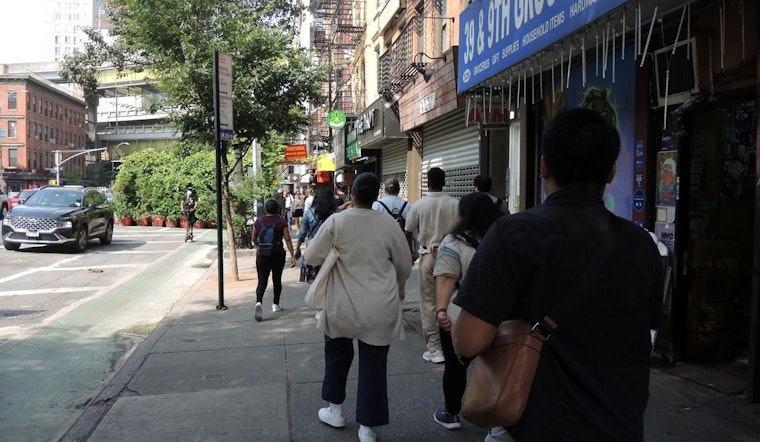
Ninth Avenue in Hell's Kitchen is getting a fast-tracked makeover that is set to carve out more room for people on foot, on bikes, and on buses. On Thursday, the New York City Department of Transportation rolled out a surprise redesign for the stretch between West 34th and West 50th streets that will add a nine-foot "super sidewalk," widen the avenue’s protected bike lane, and stripe a new curbside bus lane meant to move transit riders past traffic jams.
DOT says work will start right away and is scheduled to wrap by late summer or early fall, so regulars on Ninth should expect the street to look very different by the time the weather cools down.
Design Details And Safety Case
In a press release, NYC DOT laid out the particulars. The protected bike lane on the east side of Ninth Avenue will grow from five feet to nine feet, and the agency will paint an additional nine feet of pedestrian space beside it, creating what DOT is branding a "super sidewalk."
On the west side of the avenue, nearly a half-mile of curbside bus lane between West 34th and West 50th streets will be painted red. According to the same release, that lane will be in effect seven days a week from 7 to 10 a.m. and 4 to 7 p.m., and will be eligible for enforcement during those hours.
DOT also points to a serious safety rationale. The agency describes Ninth Avenue as a Vision Zero priority corridor and reports that 37 people were killed or seriously injured along this stretch between 2021 and 2025.
Design Changes Build On Earlier Work
Advocates and planners see the move as the next step in a years-long effort to reclaim Midtown street space from cars and hand it back to people. As Streetsblog reported, DOT first tested painted "super sidewalks" on Ninth Avenue uptown during utility work in 2023, pitching the design as a faster and lower-cost way to widen pedestrian areas without waiting for full concrete work.
Supporters have praised that extra room as a pressure valve for some of Midtown’s most crowded sidewalks, where pedestrians often spill into the bike lane or traffic lanes. Critics, on the other hand, warn that paint on its own can become a magnet for illegal parking and loading, especially if enforcement is sporadic or if there are no physical barriers to back it up.
Bike Lanes And Transit Speed
The Ninth Avenue overhaul fits into a broader city push to widen bike lanes and give buses more priority in Midtown. On nearby 10th Avenue, the city installed a 10-foot "double-wide" protected bike lane in 2023 that allows cyclists to comfortably ride two abreast, according to amNewYork. Officials have said wider lanes help make space for bulkier and faster e-bikes and can cut down on conflicts between riders.
Transit and street safety advocates argue that pairing a wider protected lane with a clearly marked, red curbside bus lane could be a powerful combo, improving both travel times and safety along Ninth Avenue, as long as enforcement of the new rules keeps up with the redesign.
Construction Schedule And What To Expect
According to the same NYC DOT release, the heavy lifting on Ninth Avenue will run from mid March through mid June. That work will include repaving, building concrete pedestrian islands, and repainting lane lines.
Additional lane markings tied to the FIFA World Cup are scheduled for non-game days only, a detail DOT is flagging early for anyone worried about game-day gridlock. The agency still expects the overall project to finish by late summer or early fall.
For anyone seeking more details or official updates, DOT lists media contacts at (212) 839-4850 and [email protected].
Local advocates have largely welcomed the extra breathing room for people walking and biking, while nudging DOT to go further where possible. They are pushing for more concrete curbs and stronger enforcement so the new space is not quietly reclaimed by parked cars and delivery trucks. Streetsblog has previously chronicled both the enthusiastic reception to wider pedestrian zones and the sometimes messy enforcement issues that follow when projects rely on paint instead of permanent infrastructure.
For neighbors, workers, and commuters who use Ninth Avenue every day, the overhaul is meant to tilt the balance away from through-traffic and toward the way the corridor actually functions: as a place where people walk, bike, shop, and wait for the bus. In the short term, that will mean construction noise, detours, and fresh asphalt. By the time the summer events season is in full swing, though, DOT is betting that a super-sized sidewalk, a roomier bike lane, and a dedicated bus lane will make Hell's Kitchen’s main drag feel a little less like a cut-through and a little more like a livable avenue.




