

























































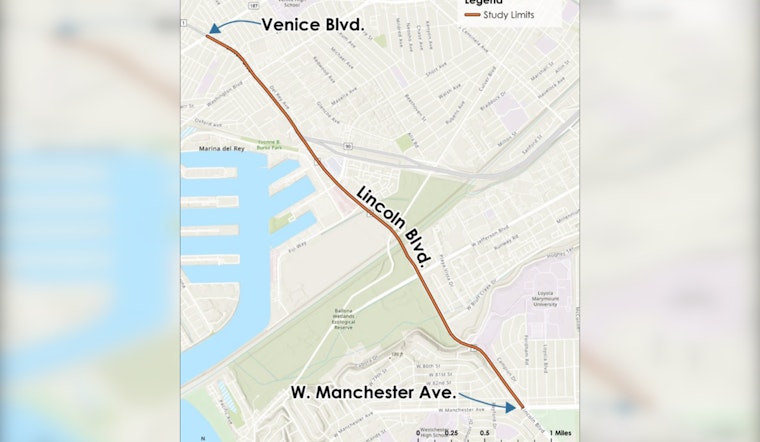
Rush hour on Lincoln Boulevard could be in for a shakeup, and Caltrans wants locals to help decide how big that shakeup should be. The agency is asking Angelenos to weigh in on a proposal to extend peak-hour bus lanes along roughly 3.1 miles of Lincoln Boulevard between Venice Boulevard and West Manchester Avenue. The idea is to speed up buses and improve reliability for riders on Route 3 and Rapid 3. The draft feasibility study is open for public comment through April 17, 2026, and Caltrans is emphasizing that this is an early look at what might be possible, not a green light for construction.
What Caltrans Is Proposing
In its draft Extension of Peak-Hour Bus Lanes on Lincoln Boulevard Feasibility Study, Caltrans examines bi-directional, peak-hour bus-only lanes on State Route 1 from Venice Boulevard to West Manchester Avenue. According to Caltrans, the goal is to make better use of the existing right-of-way, improve transit frequency and reliability, and better serve people traveling to Santa Monica, Marina del Rey, and LAX. The report comes with a StoryMap, technical appendices, and a timeline showing previous rounds of public outreach.
Why Riders And Advocates Are Paying Attention
Santa Monica’s Big Blue Bus, the main transit operator along this stretch, has come out in favor of creating a more continuous bus-lane network, arguing that dedicated lanes can cut travel times and make service more dependable. As reported by the Santa Monica Daily Press, agency officials say expanding bus-only lanes would shorten trips for riders and help ease congestion for drivers, cyclists, and pedestrians. The Santa Monica Mirror notes that Route 3 and Rapid 3 together serve more than 1.35 million riders a year, and that roughly 75% of Route 3 riders earn under $50,000, a key equity point for supporters.
Tradeoffs To Expect
The feasibility study looks at several options, ranging from part-time, peak-hour bus lanes to full-time dedicated lanes, and considers potential lane reductions and effects on on-street parking. According to Caltrans, outreach so far has included surveys, open houses, and canvassing along the corridor to better understand community priorities. Business owners and residents are expected to focus on issues like parking, delivery access, and curbside changes as any detailed designs are developed.
How To Weigh In
The draft study and all supporting documents are available online, and the public comment window runs through April 17, 2026. Caltrans is taking feedback through its engagement portal, where the agency has posted maps, alternatives, and a StoryMap so people can review options before weighing in. If the study ultimately identifies a preferred alternative, Caltrans says it would still need to go through its usual design and environmental review processes and continue community outreach before any construction is proposed.





