

























































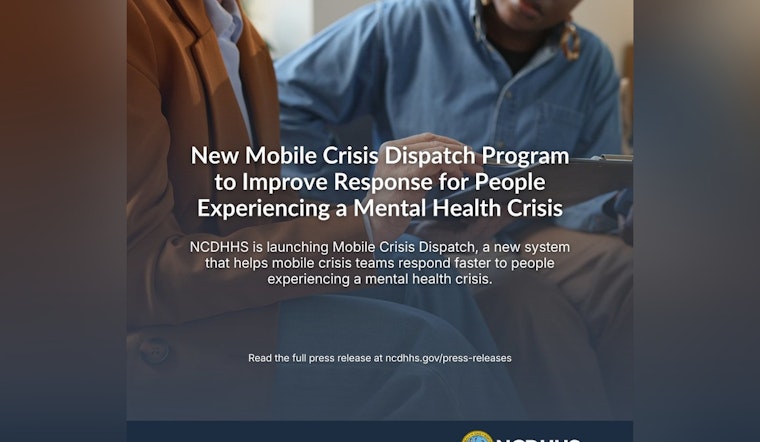
North Carolina is rolling out a statewide test of a new way to get in-person help to people who dial 988, and Raleigh is out front. The Mobile Crisis Dispatch pilot, announced March 5, 2026, lets 988 counselors request mobile crisis teams and track those deployments in real time through a shared dispatch platform. State leaders say the goal is to shorten response times and cut unnecessary police involvement so callers can get clinicians or peer support to meet them where they are. The pilot is part of a broader push to expand community crisis centers, mobile teams, and alternatives to emergency-department care.
How the dispatch pilot will work
Under the pilot, 988 counselors will be able to generate a dispatch request that feeds into a shared deployment platform so mobile teams receive more complete, trackable referrals. The tool, NCDHHS says, "connects people directly to trained counselors who can come to them and provide support," and officials say it is intended to speed up the response when someone reaches the lifeline. In its post, the agency pointed to a press release with additional operational details.
Where this fits into North Carolina’s crisis system
The pilot plugs into a crisis continuum that already includes 988, peer warm lines, mobile crisis teams, and facility-based crisis centers. Reporting by North Carolina Health News has documented tens of thousands of contacts to the state’s 988 operation in its early years and hundreds of referrals to mobile teams, a sign of growing demand for faster in-person responses. Advocates say pairing phone-based support with reliable field teams is crucial to keep people out of emergency departments and to avoid unnecessary police involvement when a clinical or peer response would be safer.
Technology and funding behind the pilot
The new dispatch tool will tie into the state's BH SCAN platform so staff can see team availability, create digital referrals and track outcomes as part of a broader move to modernize crisis technology and data. State planning documents list a "mobile crisis dispatch & tracking pilot" among near-term priorities and describe multi-year investments intended to expand mobile teams and crisis stabilization capacity. As outlined by the N.C. Department of Health and Human Services, the overarching aim is faster, more accountable responses that keep people in the community when that is clinically safe.
Why advocates and federal guidelines back it
Federal guidance recommends integrating 988 with mobile crisis and stabilization services so phone-based counselors can quickly connect people seeking help with local, on-the-ground teams. SAMHSA's national crisis care guidelines couple a "someone to talk to" with a "someone to respond," and the FCC has adopted georouting rules designed to help callers reach nearby resources instead of distant centers. Advocates say those technical fixes, combined with a shared dispatch platform like North Carolina’s pilot, can trim the delays that now leave some people waiting for hours or routed to nonlocal providers.
How to get help now
If you or someone else is in crisis, call or text 988 to reach a counselor, and for life-threatening emergencies, call 911. NCDHHS maintains a searchable list of local mobile crisis teams and notes that 988 counselors can coordinate in-person responses when that is clinically appropriate. The directory includes local phone numbers and county-by-county coverage.
State officials say the pilot's first phase will be monitored for response times and outcomes, with lessons used to guide any broader rollout. The department expects to publish evaluation results and next steps as the test progresses later in 2026.




