

























































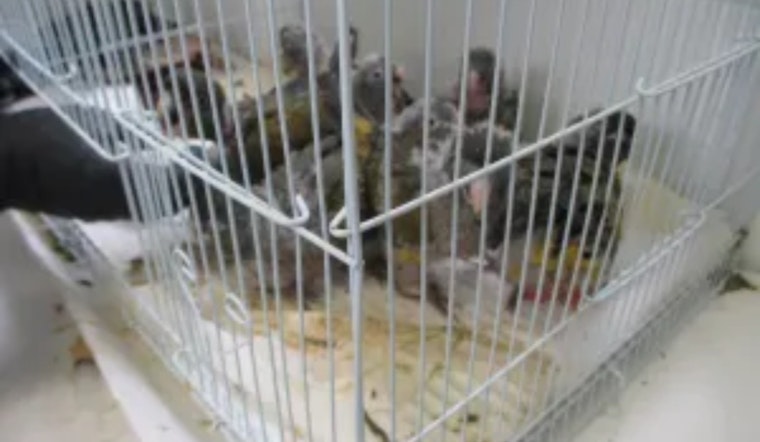
Federal officials say Ricardo Alonzo is headed to federal prison for three months after admitting he smuggled 17 protected parrots and parakeets into the United States. The birds – 10 burrowing parakeets, five yellow-crowned Amazon parrots, and two red-lored Amazon chicks – were packed into bags hidden under the rear seat of his car as he crossed at the San Ysidro Port of Entry in May 2025. Authorities say two of the juvenile birds did not survive the trip.
Seizure details and charges
According to a press release from the U.S. Attorney’s Office, U.S. Customs and Border Protection officers stopped Alonzo on May 4 and found four small bags tucked beneath the rear seat of his vehicle. The surviving birds were moved to a USDA quarantine facility, where they could be held and monitored. Prosecutors charged him with importation contrary to law after investigators concluded the animals had not been declared and the required permits were missing. The complaint notes that the birds were juveniles, likely only a week to a few months old, which raised red flags about animal welfare and the risks posed by the way they were transported, per the U.S. Attorney’s Office.
Why authorities flagged the shipment
Federal and wildlife officials warn that sneaking live birds across international borders is not just an animal cruelty problem; it can also bring in diseases such as avian influenza and other pathogens that threaten U.S. poultry operations and native wildlife. The species seized in this case fall under international protections that require permits and quarantine to control disease and comply with conservation treaties. As U.S. Customs and Border Protection has pointed out in similar busts, trafficking live birds fuels illegal capture and weakens already vulnerable populations abroad.
Sentence and plea
Local reporting says Alonzo pleaded guilty and received a three-month prison term, a sentence reported by FOX 5 San Diego yesterday. Prosecutors relied on federal importation and wildlife laws, including provisions of the Lacey Act and the importation contrary to law statute. When charges were first filed, the U.S. Attorney’s Office stressed that importing parrots and parakeets legally is a paperwork-heavy process that must include quarantine to safeguard both animal and human health.
A pattern at the border
Prosecutors and local outlets say this was not a one-off case. They describe it as one of several recent bird-smuggling attempts intercepted at San Diego-area crossings, including a separate incident earlier in the spring in which officers discovered a dozen parakeets at Otay Mesa. Federal authorities say this cluster of seizures highlights the region’s role as a trafficking corridor for exotic birds and underscores the need for sustained enforcement at busy ports of entry. Times of San Diego and other local coverage first detailed the charges, while Hoodline’s report on the earlier bird smuggling charges provided added context.
Legal implications
Federal importation laws and the Lacey Act are the main legal tools in play in cases like this. Importation contrary to law falls under 18 U.S.C. § 545, while the Lacey Act, at 16 U.S.C. § 3372, makes it illegal to import or traffic wildlife that was taken or traded in violation of U.S. or foreign law. For readers who want to dig into the fine print on penalties and prohibited conduct, the statutory language is available at 18 U.S.C. § 545 and 16 U.S.C. § 3372 (Lacey Act).





