

























































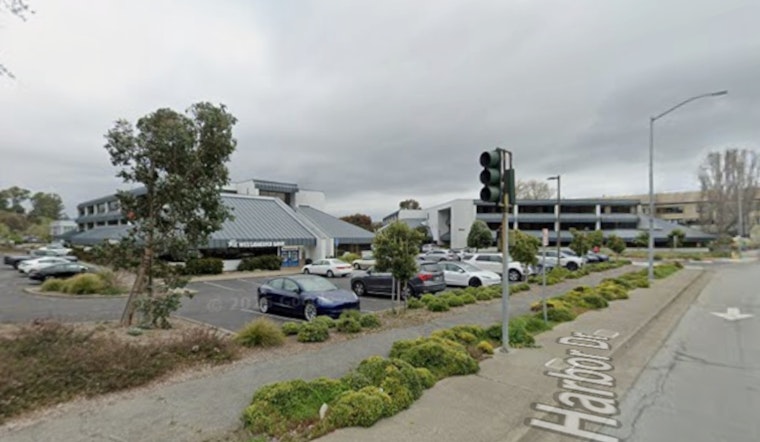
A nearly 300-unit apartment complex is suddenly on deck for Sausalito, and it is not subtle. A developer has submitted plans for a 294-unit building at 1 Harbor Drive, along the Bridgeway corridor, in what would be the largest residential project the seaside city has seen in decades. The proposal landed just months after voters approved Measure J to rezone portions of the corridor for higher-density housing.
The pre-application envisions a six-story building across from Mollie Stone’s that would replace the existing office at 1 Harbor Drive while leaving the neighboring office at 3 Harbor Drive intact. The plan calls for a mix of studios, one-, two- and three-bedroom apartments, with 46 homes reserved for very low-, low- and moderate-income households. For a town that permitted only 58 units in its last Regional Housing Needs Allocation (RHNA) cycle, this is less incremental growth and more a scale jump.
Bayspring Development Partners filed the pre-application for the 1 Harbor Drive site, describing the parcel as a “cornerstone opportunity” to deliver significant new housing, according to the San Francisco Chronicle. The Chronicle reports that architect AC Martin has designed the project with two levels of parking topped by four floors of housing, and that the affordable component qualifies the proposal for a 100 percent density bonus. The outlet also notes that the project would be eligible for ministerial approval, which removes it from discretionary California Environmental Quality Act (CEQA) review and is expected to speed up approvals.
Measure J, RHNA And Why Sausalito Rezoned
Sausalito placed Measure J on the November 2025 ballot to rezone 12 parcels and concentrate most new housing on a small set of commercial properties along the Bridgeway corridor. The move was aimed at meeting a state mandate to plan for 724 homes between 2023 and 2031. City housing documents note that the 724-unit target represents roughly an 800 percent increase over the previous RHNA cycle, which is why the council put the high-density overlay before voters.
Those same materials explain that the rezoning was crafted to channel new housing into already developed commercial areas, avoiding displacement of maritime and industrial uses and aiming to preserve the city’s working waterfront character. In other words, if Sausalito had to absorb a dramatic jump in planned housing, officials preferred to steer it toward office and retail sites rather than docks and boatyards.
How Approvals And CEQA Limits Reshape The Fight
Because 1 Harbor Drive falls inside the Measure J overlay, the proposal qualifies for ministerial review. That is planner-speak for a process where staff check a project against pre-set, objective standards and, if it complies, issue approvals without discretionary hearings. The result is fewer traditional levers for neighbors to slow or block the project through appeals or drawn-out political battles.
As outlined in Marin County Elections materials, Measure J was pitched as a way to bring Sausalito into line with state housing law and to avoid potential legal or financial penalties if the city failed to rezone enough land. Supporters argued that clear, ministerial standards were necessary to shield the city from years of litigation. Critics countered that compressing review into a more technical, checkbox process would reduce transparency and public input on projects that could remake whole blocks.
Other Parcels, Other Developers And The Local Picture
The Bayspring filing is the headline act, but it is not the only show Measure J made possible. City planners and local reporting have flagged several other Bridgeway parcels, including 2650 and 2656 Bridgeway and 2680 and 3000 Bridgeway, as likely candidates for redevelopment that could add dozens more homes.
The San Francisco Chronicle reports that developer Dan Morgan has floated the idea of building roughly 65 to 80 units on two Bridgeway properties. The Chronicle also notes that Sausalito’s last notable housing development was Rotary Village, a 22-unit project completed back in 2004. In that context, a 294-unit proposal was always going to turn heads. “I don’t think anybody should be surprised by the size of the project,” Marin land-use attorney Riley Hurd told the Chronicle.
Next Steps And What To Watch
The pre-application is a starting gun, not a building permit. Bayspring still has to submit formal plans, obtain building permits and comply with the city’s objective design standards where they apply. Sausalito’s housing documents describe a set of expedited review tracks and incentives for projects that include below-market-rate units, and staff have indicated they intend to use the overlay to move qualifying proposals through the pipeline more quickly.
Neighbors and local organizations are expected to closely monitor the formal application and staff findings, since any challenge will likely hinge on whether the design complies with the letter of the Measure J standards. If Bayspring’s plan checks every box, city officials will have limited room to say no, regardless of how big the project feels on the ground.
Whether this Harbor Drive proposal becomes the first in a string of new buildings or the singular project that reshapes Sausalito’s skyline will depend on the next several months of design tweaks, permit decisions and local politics. What is clear is that the Bridgeway corridor has already shifted from theoretical rezoning to concrete plans, and Sausalito is about to find out how much density its voters effectively signed on to.





