

























































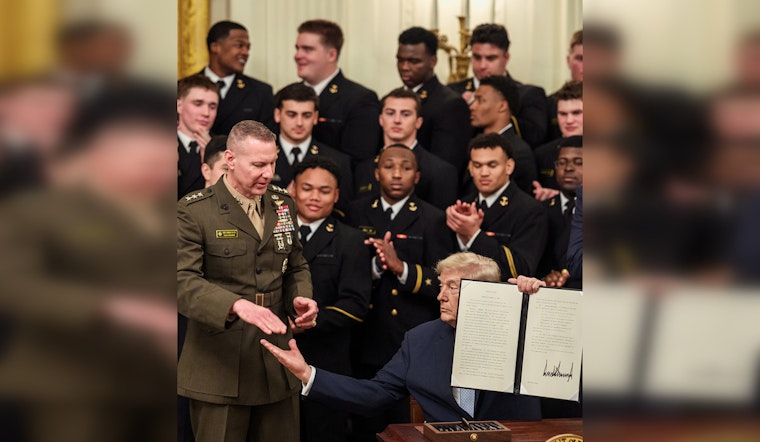
President Trump has put the weight of the federal government behind the Army‑Navy football game, signing an executive order on Thursday that is designed to shield the rivalry's traditional second‑Saturday‑in‑December kickoff from competing college‑football telecasts. The order, described by a local outlet as titled "Preserving America's Game," would carve out an "exclusive window" on television so that no other college football is shown in direct competition, turning what used to be a scheduling and media‑rights haggle into federal policy.
According to the Tampa Free Press, the order directs the Commerce secretary and the chair of the Federal Communications Commission to coordinate with the College Football Playoff management committee and the NCAA to set up the exclusive window "within existing laws and budget limits." The paper reports that the document calls the game a "symbol of excellence and the American spirit" and says the Department of War will cover the costs of publishing the order. If that account is accurate, the directive would tell federal agencies to lean on regulatory tools and interagency coordination rather than new appropriations to carry out the policy.
The White House move follows a public pledge by the president in January to sign an order guaranteeing a four‑hour exclusive broadcast window for Army‑Navy as the College Football Playoff considers expansion, an idea first reported by sports outlets including ClutchPoints. That promise came while CFP leaders were debating formats, including proposed play‑in games that could overlap with the service academies' matchup. Supporters say protecting the window preserves a national tradition, while critics argue it drags federal power into television scheduling.
CFP officials have signaled they know the issue is politically charged. As CBS Sports reported in January, CFP executive director Rich Clark said, "We saw it and understand where the administration's position is," although the committee has not announced a final expansion format. His comments highlight how a presidential directive could add another layer of complication to already tense negotiations among conferences, networks and the playoff office.
How Agencies Could Act and the Legal Limits
The order tells the Commerce Department and the Federal Communications Commission to work with rights holders while stressing that agencies must act "within existing laws and budget limits," a signal that the administration is looking to regulatory maneuvering instead of new legislation. The FCC's public‑interest obligations give it some basis to examine whether licensees are serving viewers' needs, but the agency's enforcement powers and constitutional limits mean any push to police specific programming schedules could invite legal challenges, according to a Federal Communications Commission public notice.
What It Means for Networks and the Playoff
Broadcasters and rights holders still control the contracts that actually set kickoff times. CBS holds Army‑Navy rights under a long‑term deal, according to ClutchPoints. CFP expansion plans have included play‑in games that could overlap with the service academies' start time, but some proposed formats, including a 16‑team field or staggered play‑ins, could be structured to avoid that conflict, as reported by CBS Sports. Networks are likely to weigh their contractual options alongside the political pressure if the order moves from symbolic gesture to real scheduling constraint.
How the directive plays out will ultimately depend on the exact language in the written order and on how aggressively federal agencies decide to press broadcasters, a path that could prompt litigation or force a formal rulemaking process. The Tampa Free Press report says the Department of War will cover publication costs and frames the measure as a morale‑building move, while critics counter that federal involvement in sports scheduling sets a worrying precedent. For now, the CFP, the NCAA and television networks still hold the practical power to keep games off each other's airwaves, and they will have to decide whether to adjust quietly or push back.





