

























































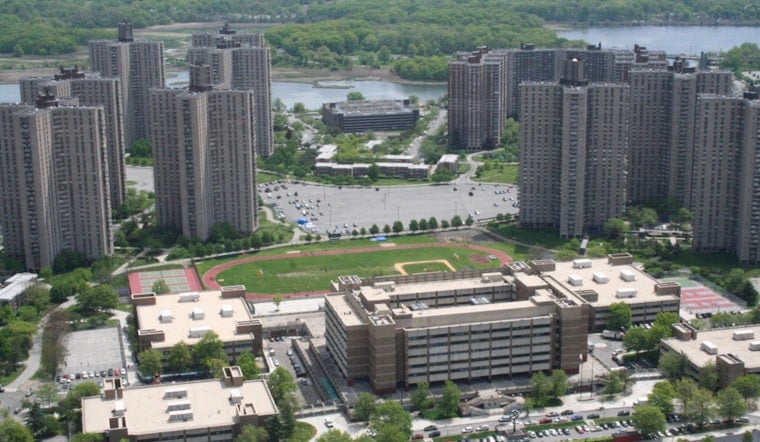
Sticker shock is sweeping through Co-op City, the 15,372-unit Mitchell-Lama cooperative in the northeast Bronx, after residents were warned that New York’s climate rules and recent utility decisions could send monthly maintenance bills soaring.
Community leaders say everything now hinges on what happens to the complex’s on-site power plant. If it can be retooled at a price the co-op can handle, shareholders might be spared the worst of it. If not, residents could be on the hook for eye-popping increases.
Jeffrey Buss, general counsel for Riverbay Corporation, which runs Co-op City, told the New York Post that converting or retiring the on-site natural-gas tri-generation plant to meet state climate targets could push monthly maintenance on a one-bedroom from roughly $950 to more than $4,000. He also warned that rewiring and related upgrades might cost “as much as $1,000,000,000.” Those numbers have sparked immediate pushback from tenant advocates and trade groups who say middle- and working-class shareholders are being squeezed from all sides.
The plant that keeps Co-op City running
Co-op City runs its own tri-generation plant, meaning electricity, heat, hot water and air conditioning are all bundled into shareholders’ maintenance bills, according to Co-op City. A technical assessment by NYSERDA describes the campus combined heat and power system in detail, noting a combined output in the high tens of megawatts and turbines that have historically run on natural gas, with oil as a backup fuel.
Co-op City and NYSERDA together lay out why the property is so unusual in New York: the complex is practically its own utility, with a campus-scale energy system that touches every apartment and every common area.
How statewide rules and utility costs collide
New York’s Climate Leadership and Community Protection Act sets aggressive targets for the power sector, including a high share of renewables by 2030 and deep emissions cuts in the 2040s. Those goals will require major changes in how big, centralized heat-and-power systems like Co-op City’s operate in the coming decades.
Guidance from the New York State Department of Environmental Conservation lays out the transition timeline, while materials from the New York State Public Service Commission detail a multi-year Con Edison plan that will raise delivery costs for customers in 2026 through 2028. Those documented rate hikes translate into real monthly dollars for typical households and feed directly into how Co-op City budgets both its energy spending and any major capital work on the plant.
Why retrofits could be so expensive
Riverbay has warned that taking a campus built around an on-site gas plant and turning it into a zero-emissions operation would mean extensive rewiring, new distribution systems and either full electrification or costly alternatives such as hydrogen or carbon capture.
Buss has said the site’s turbines can handle a modest blend of hydrogen, but large-scale hydrogen delivery and storage are not in place yet. State planning documents make a similar point as New York pilots hydrogen-related projects. Riverbay’s figures and warnings were laid out earlier this week in an interview published by the New York Post, while Albany has touted early hydrogen hub work in the region. An announcement from the Office of Governor Kathy Hochul makes clear that effort is still at an exploratory stage.
Legal timing and exemptions
Local Law 97, New York City’s building-level emissions law, treats certain affordable and Mitchell-Lama properties differently. The Department of Buildings’ compliance matrix includes a 2035 pathway for qualifying Mitchell-Lama campuses, which shapes the timetable for any major retrofit at Co-op City.
Guidance from the NYC Department of Buildings explains Article 320 and Article 321 compliance paths for different building types and the forms owners must file. Large campuses like Co-op City get extra planning time, but they are still required to report emissions and eventually bring them down.
For residents, the immediate question is straightforward: can Albany create compliance options and funding that protect affordability while still cutting pollution? Riverbay and co-op organizations have pushed for delays or targeted financial support, while climate advocates insist that emissions targets must hold. More hearings, letters and technical studies are almost guaranteed as state and city officials try to reconcile climate policy with the financial realities at one of the country’s largest affordable housing complexes.





