

























































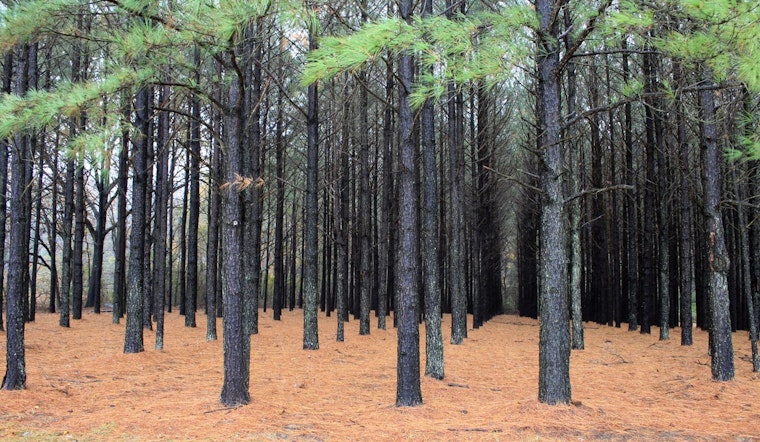
Oklahoma landowners sitting on hard-to-farm acres might soon see those fields in a very different light. Researchers at Oklahoma State University say emerging carbon markets could turn so-called marginal land into money-making ground by making loblolly pine plantations financially feasible in places where timber income alone usually falls short. A new economic model created by an OSU master's student finds that carbon payments can tip the balance on low-productivity sites, changing how owners think about planting trees instead of letting ground sit idle. That could matter across eastern Oklahoma, where tough soils and hit-or-miss rainfall often limit reliable crop production.
According to The Journal Record, the model was developed by Sydney Vieira, a graduate student in agricultural economics who is scheduled to finish her degree in May. Her analysis ran dozens of land-quality scenarios that shifted timber prices, land productivity and interest rates. As reported by The Journal Record, timber-only plantings on marginal Oklahoma parcels did not currently pay off, largely because pulpwood prices are relatively low and tree growth is slow. Vieira focused on loblolly pine in eastern Oklahoma and tested whether carbon payments could close that profitability gap.
How the model works
To build the scenarios, Vieira used the Forest Vegetation Simulator to estimate tree growth and carbon accumulation under different management and soil conditions. That allowed the team to test various rotation lengths and thinning schedules without waiting decades for real harvest data. The Forest Vegetation Simulator, a tool from the U.S. Forest Service, models how forest stands develop over time. The OSU team then translated those biological projections into dollars by layering in different timber and carbon price assumptions, a standard move in forestry economics when assessing how carbon payments can alter land-expectation values.
What it means for landowners
When the researchers ran budgets that relied only on timber revenue, many of the lowest quality sites lost money on paper. Once potential carbon payments were added, however, the margins improved enough that planting trees started to look realistic for at least some owners of marginal acres. "We're saying consider something else," Lixia Lambert, Vieira's faculty advisor, told The Journal Record. The study does not promise quick jackpots, and the bottom line will still depend on how generous and long-lasting carbon contracts are, how expensive verification turns out to be and where pulpwood markets go in the future.
Market and policy context
In the voluntary carbon market, buyers can pay landowners for measured, verified carbon storage, but the appeal of those deals hinges on design details such as contract terms and verification costs, especially for smaller tracts. The OSU work ties into a broader effort to study how efficient and socially acceptable carbon-based forest management really is on marginal forestland in the state, according to USDA NIFA. On the policy side, Oklahoma has been moving to clarify how carbon storage and oversight should work, including legislation such as the state’s Oklahoma takes charge of carbon capture regulation, a backdrop that could shape how forest-based offsets are handled on the ground.
What comes next
Researchers say the next phase is all about outreach and pilot projects that help connect willing landowners to carbon programs while keeping verification and transaction costs low enough to matter for small properties. Oklahoma State has been building tools for biomass and forest economics for several years, and its extension efforts are expected to drive how these latest results turn into practical advice for landowners, according to an Oklahoma State University agriculture release. For now, the study points to a fresh option for owners of marginal acres, one that could nudge property values higher if carbon prices and market access line up.





