

























































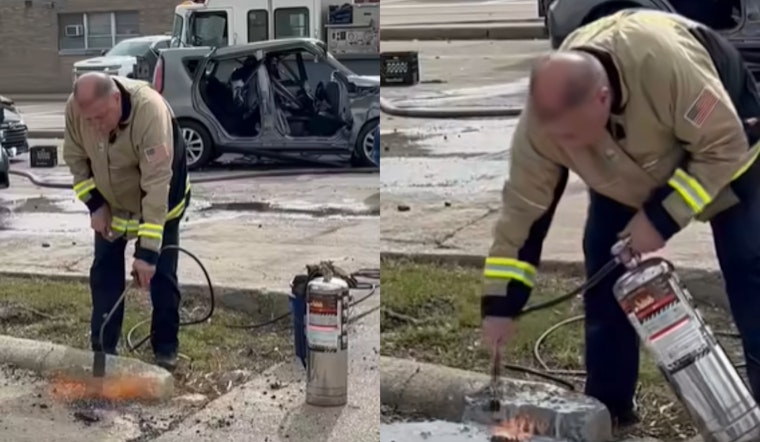
On Saturday, the Cleveland Division of Fire turned training into a live science lab, staging a hands-on “Fire Science Saturday” to see how a water additive called F-500 encapsulator agent performs on some of today’s nastiest fires, including lithium-ion battery, magnesium and vehicle blazes. Crews reported faster cooling and less smoke during the real-time burns, and officials said the agent will now ride in 5-gallon pump tanks on every CFD apparatus as an extra tool for emerging fire risks, with clear reminders about its limits.
Department demo in action
In a video posted by the department, crews hit a burning car, a block of magnesium and a simulated lithium-ion battery with a 1–3% F-500 solution to show how quickly it could knock down flames and cool surfaces. According to the Cleveland Division of Fire, the treated metal cooled enough to be picked up with a bare hand, and the department said it is now carrying F-500 in 5-gallon pump tanks on all apparatus. The same post noted that the additive cut the amount of water needed and reduced carcinogenic smoke.
How the agent works
According to Hazard Control Technologies, F-500 is an encapsulator agent, not a traditional firefighting foam. Its molecules form spherical micelles around water droplets, which improves heat transfer, helps strip energy from the fire and can limit re-ignition. The manufacturer recommends application rates generally between about 0.5% and 3%, depending on the hazard, and notes that the formula is fluorine-free, biodegradable and non-corrosive.
Independent testing and limits
A report by Kiwa Nederland B.V. found that F-500 produced stronger suppression than standard foam or dry powder in lithium-ion battery tests and drove temperatures down to roughly 150°C. The testers warned, however, that good suppression does not automatically mean a battery is fully extinguished, and re-ignition can still occur. That warning mirrors broader fire service guidance that thermal runaway can continue inside battery packs even after visible flames disappear.
What this means for tricky fires
Fundamentals of fire chemistry still apply. Government hazard guides note that burning magnesium can react with water and release flammable hydrogen gas, which is why metal fires call for special Class D tactics. NOAA CAMEO Chemicals and other safety references advise using dry or specialized agents for combustible-metal incidents. Manufacturers and proponents say F-500 can help cool modern fire loads while cutting smoke and soot, a claim repeated by Hazard Control Technologies, but trainers stress that the agent is an add-on tool, not a replacement for Class D methods or on-scene judgement.
Cleveland’s demonstration shows the department is putting money and training time into newer suppression options as EVs, solar equipment and lightweight metals change the city’s risk profile. For residents and firefighters alike, the message is that agents like F-500 may help knock down modern fires faster, but layered tactics, patience and caution still carry the day.




