

























































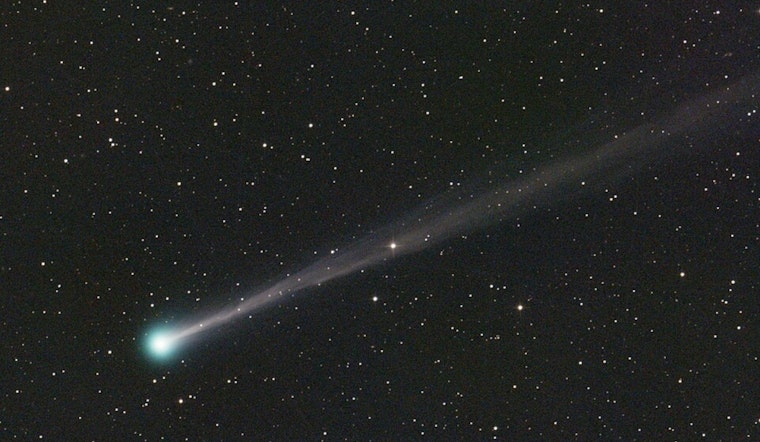
Columbus early birds are getting more than coffee for their trouble this week. Comet PanSTARRS (C/2025 R3) is hugging the low eastern horizon about an hour before dawn, a frozen visitor that astronomers estimate has not swung this close to the inner solar system in roughly 170,000 years. With clear skies and a dark, open view to the east, the comet may already be visible through binoculars and, in the best spots, to the naked eye.
When and where to look
From central Ohio, the prime viewing window runs about 60 to 90 minutes before sunrise, when the comet will sit slightly north of due east and glide near the Great Square of Pegasus. It is expected to brighten through mid-April as it approaches perihelion around April 19 to 20, and it makes its nearest pass to Earth in the final week of April, according to skywatching guides and local coverage.
For local context and early photos, WBNS has a handy morning-sky map, and national skywatching pages are tracking the comet’s path and timing.
How to spot and photograph it
City lights matter a lot here. Inside Columbus, binoculars (10x50 or similar) will greatly improve your odds, while rural stargazers may be able to pick out the fuzzy coma with unaided eyes. Short camera exposures on a tripod, or stacking a few quick frames, can reveal a greenish coma and any developing tail; guides to optics and exposure are available from major science sites and weather outlets.
Practical tips include finding a flat, unobstructed eastern horizon, arriving 30 to 60 minutes before the best window so your eyes can adjust, and using a star app to line up the Great Square of Pegasus as a reference point for framing photos.
Why this sighting is special
Comet C/2025 R3 appears to be a long-period visitor from the distant Oort cloud. Orbital solutions and reporting estimate its last trip through the inner solar system was on the order of 170,000 years ago, which makes this effectively a once-in-a-lifetime show. That said, comet brightness is notoriously hard to predict, and experts caution that activity can ramp up or fade as the icy nucleus responds to solar heating.
Skywatching ephemerides derived from JPL data show the comet reaching perihelion in mid-April and its closest Earth approach in the last week of April, although the sun’s glare may make the object harder to spot right around the time it is nearest.
If you manage to snag a good shot of PanSTARRS, local station 10TV is accepting viewer photos by text or email and may feature community images on the morning show. Clear skies and a low eastern horizon remain your best allies for catching this once-in-many-millennia visitor.
Sources: reporting and sky maps from Space.com, viewing guides from Live Science, ephemerides summarized by TheSkyLive, national weather coverage at Weather.com, and local reporting at WBNS.





_on_8_April_2026.jpg)