

























































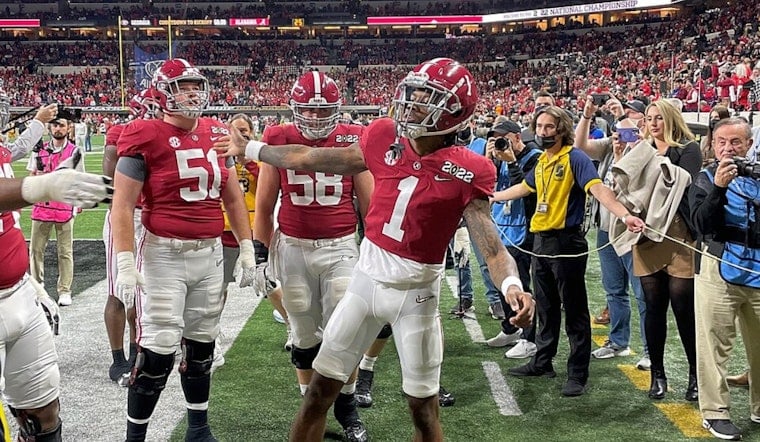
Detroit Lions wide receiver Jameson Williams is taking his college past to court, filing a civil lawsuit in Los Angeles County on Monday, that accuses the NCAA, the Big Ten and the SEC of profiting off his name, image and likeness without paying him fairly. The complaint asks a judge to bar the three organizations from using his NIL without his consent and seeks money damages tied to social media earnings and broadcast licensing revenue. The case instantly jumps near the top of the list of individual NIL battles to emerge in the wake of the House settlement that reshaped the college sports economy.
According to the New York Post, court documents obtained by The California Post show Williams is seeking not just an injunction, but also the “social media earnings” he says he missed out on and a share of the “game telecast group licensing revenue” he alleges the defendants collected in part because of his college performance. The complaint states, “To date, Williams has received no fair compensation from Defendants for the full commercial value of his name, image, and likeness.”
What the suit claims
Williams’ lawsuit argues that the NCAA, Big Ten and SEC used his image and highlight clips in social media posts and television packages without cutting him in, and it grounds those claims in a stack of legal theories: the Cartwright Act, a state Unfair Practices claim, the Sherman Antitrust Act and the Lanham Act. As reported by On3, the filing contends he should be reimbursed for the money he says a truly competitive NIL marketplace would have paid him.
How his college career factors in
The complaint ties those alleged losses directly to Williams’ college production. After transferring to Alabama in 2021, he broke out with 79 receptions for 1,572 yards and 15 touchdowns in a single season. Before that, in two seasons at Ohio State, he totaled 15 catches for 266 yards and three touchdowns. Those year-by-year totals and game logs are laid out on public stat pages and team bios, which Williams’ lawyers cite as the foundation for the highlight reels and promotional content now at issue. ESPN and the Ohio State site both document those collegiate numbers.
Where this fits in the wider NIL fight
Williams’ personal lawsuit lands on top of a much larger legal pile: the multibillion-dollar House v. NCAA settlement that rewired how past and current players can be paid. That framework, approved by the courts, set up roughly $2.78 billion in back payment and opened new revenue-sharing channels for Division I athletes. Legal observers see Williams’ case as a test of whether individual players can chase additional remedies, such as direct slices of broadcast-licensing pools or retroactive social media revenue, beyond what the settlement already provides. Public filings and court commentary have sketched out the settlement’s contours, and Winston & Strawn breaks down key elements of that approval and what it offers athletes.
Legal implications
If Williams were to win on any of his antitrust or Lanham Act claims, it could carve out a narrower path for former players to seek payment for past uses of their images in conference and league marketing. That is a big “if,” given that similar efforts have stumbled over procedural hurdles and statute-of-limitations defenses in prior high-profile cases. Courts have already shown a willingness to shut the door on certain retroactive claims. For a sense of how timing and other legal defenses can complicate these disputes, observers have pointed to earlier challenges, including Reggie Bush’s post-career litigation, which ran into heavy resistance. The Los Angeles Times has detailed some of those obstacles.
What happens next
Filed in Los Angeles County on Monday, the complaint kicks off a process that will start with the usual early steps: motions to dismiss, followed by what are likely to be drawn-out discovery fights. Initial reporting notes that Williams is seeking detailed revenue information tied to telecasts and licensed highlight packages, which means both sides will probably dig into transactional records and licensing agreements. Early coverage did not mention any public response from the NCAA or the two conferences. For now, the expectation is that both the defendants and Williams’ legal team will keep pushing the case through the courts over the coming months. On3 also points out Williams’ recent pro run, including back-to-back 1,000-yard receiving seasons, as context for why the money in dispute looks even more significant at this stage of his career.





