

























































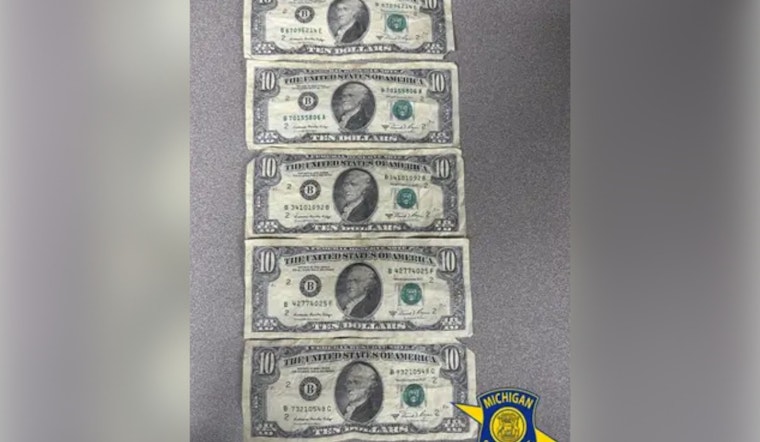
What started as a few sketchy $10 bills at a Benzie County Dollar General has ended with a Grand Rapids man behind bars after a five-month Michigan State Police investigation. Troopers say a search of a hotel room near Gerald R. Ford International Airport turned up counterfeit cash, a fraudulent check, electronic devices and a printer, part of what they allege was an operation that pumped roughly $30,000 in fake currency into multiple states.
According to FOX 2 Detroit, the case kicked off in late October when a bogus $10 bill surfaced at the Dollar General on Reynolds Road in Interlochen. Troopers then uncovered two nearly identical reports in Grand Traverse County and began coordinating with local, state, federal and out-of-state agencies. Investigators say that work, which included multiple search warrants, eventually pointed to 56-year-old Matthew Wilson of Grand Rapids as a suspect.
Arrest and Search
Michigan State Police’s Sixth District Fugitive Team tracked Wilson to a hotel near the Grand Rapids airport on March 27 and arrested him on an outstanding warrant, according to Manistee News. Troopers searching the room reported finding additional counterfeit currency, a fraudulent check, several electronic devices, and a printer and materials they say matched up with producing fake bills. Investigators also noted that two other people at the scene had recently traveled from Malaysia, and the work of pinpointing more victims and jurisdictions is still underway.
Charges and Court Schedule
Prosecutors in Benzie County have authorized a five-count felony warrant charging Wilson with uttering and publishing counterfeit bills or notes. Authorities allege he manufactured about $30,000 in fake currency that moved across 15 states, and he was arraigned in the 85th District Court on April 6. A judge set his bond at $250,000 cash or surety, and Wilson is due back in court on April 20, as reported by 9&10 News. Law enforcement officials say fully extraditable warrants have also been issued in other jurisdictions, including Iowa and North Dakota.
Bigger Picture
This is the latest in a run of counterfeit cases across Michigan this winter, a trend police say is helped along by modern printers and online marketplaces that make it easier to slip fake cash into everyday transactions. Earlier this year, Michigan State Police seized about $36,400 in counterfeit $100 bills in a separate investigation, according to ClickOnDetroit. Officers say tight coordination with federal partners is often crucial to tracing who is making the money and where it is being passed.
Troopers say the investigation into Wilson’s alleged operation is still active, and more charges or arrests could follow as agencies in other states sort through the evidence. Anyone who believes they have received a counterfeit bill is urged not to put it back into circulation and to contact local law enforcement or the U.S. Secret Service to report it.





