

























































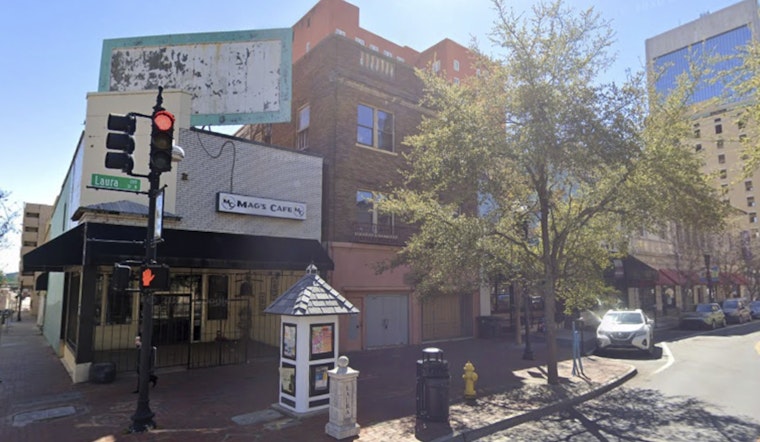
Jacksonville’s latest fight over downtown’s future is playing out at the corner of Laura and Monroe streets, where roughly $3.53 million in proposed city loans to rehab long-vacant buildings has split City Council committees and set up a tense vote next week.
The money would help convert empty storefronts into ground-floor shops or restaurant space with small apartments above, part of the city’s ongoing effort to put more residents and foot traffic back into the urban core.
Committee Votes Expose Fiscal Fault Lines
On Tuesday, the Council Finance Committee voted 5-1 to recommend approval of the two ordinances. A few doors down the hall, the Neighborhoods, Community Services, Public Health and Safety Committee went the other way, voting 4-3 against recommending them, largely over concerns about how much of the loans could be forgiven.
In the NCSPHS Committee, Mike Gay, Randy White, Ken Amaro and Michael Boylan voted no. In Finance, Rory Diamond was the lone no vote. That split result means the package now heads to the full council with the political fault lines fully visible, according to the Jax Daily Record.
What the Ordinances Put on the Table
The measures, filed as Ordinance 2026-0219 and Ordinance 2026-0218, would authorize Downtown Preservation and Revitalization Program loans of up to $1,907,345 for 231 N. Laura St. and up to $1,620,655 for 38–44 W. Monroe St.
Staff documents say about $1,525,845 of the Laura Street package and about $1,296,555 of the Monroe Street package could be forgiven, with the remaining amounts structured as deferred principal loans. Those deferred loans would accrue interest and eventually be repaid, all funded from the Northbank tax increment fund.
Plans call for about 2,800 square feet of leasable commercial space and two one-bedroom apartments at the Laura Street building, and roughly 2,700 square feet of retail space plus four one-bedroom units at the Monroe Street property, according to City of Jacksonville Legistar.
Why the DIA Says the Incentives Matter
Downtown Investment Authority staff ran 20-year financial models and concluded the city would recover about $0.53 in benefits for every $1 it puts into the projects. The DIA says that ratio still clears DPRP benchmarks because rehabbing older historic buildings tends to be significantly more expensive than new construction.
Under DPRP rules, the forgivable portion of the loans can amortize at up to 20% per year over five years if the developers hit agreed performance targets. The deferred principal loan portion carries interest modeled on the 10-year Treasury rate and is due at maturity.
DIA staff reports and modeling form the basis for the recommendation to use DPRP financing and advance the redevelopment agreements to City Council for a final decision, as laid out in the agency’s supporting packet.
Developers and neighboring property owners told council members the numbers do not work without that city support. Carmen Godwin, whose family owns the adjacent Monroe Street building through Historic Urban Core LLC, wrote that “none of these projects are financially viable without the DIA programs,” while filings show the Laura Street parcel was recently acquired by Alan Cottrill through Global Solutions Partners. Both the written statement and ownership details were reported by the Jax Daily Record.
Clock Starts Ticking If Council Signs Off
If the full council signs off, the redevelopment agreements give the developers six months from execution to start construction and 18 months to finish. DPRP funds would be paid only after the projects are completed, and the city reserves the right to claw the money back if the buildings are sold or used for an unauthorized purpose within five years.
The agreements name the DIA as contract monitor, tying each dollar to historic-preservation requirements, construction milestones and other performance benchmarks. Those timelines, repayment terms and funding sources are detailed in the city’s agenda materials and ordinance language.





