

























































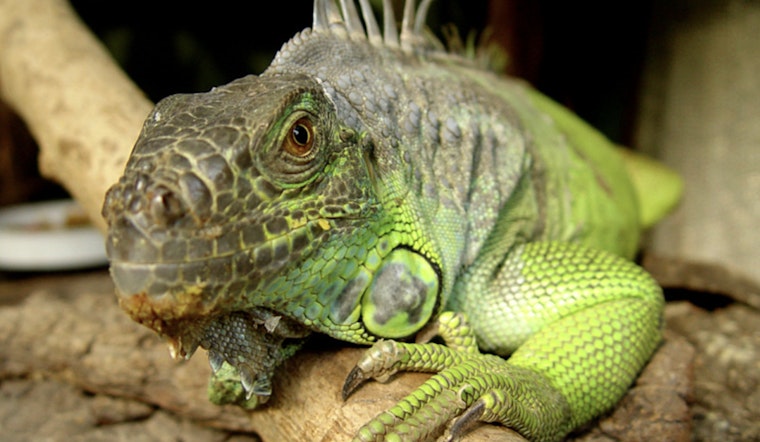
On Monday morning outside Potter Elementary, the quiet shuffle of kids heading to class came with an unexpected guest: a sizeable green iguana parked on the sidewalk by the front entrance. For a split second, the school's librarian froze. Then came the photos, a flurry of nervous staff calls and, by the next day, a full-on classroom lesson. What felt like a one-off critter encounter might actually be part of a bigger Florida story.
Andre McConico, Potter Elementary's librarian, told FOX 13 Tampa Bay he "just froze" when he spotted the reptile. Later, he turned the sighting into a teachable moment for his students. In the photo he shared, you can clearly see the large dewlap and long tail that mark it as a green iguana, a nonnative lizard species that can grow several feet long.
State records show sightings creeping north
State wildlife records show green iguanas are popping up farther north than they used to, with reports in counties including Hillsborough and Highlands, according to the Florida Fish and Wildlife Conservation Commission. Earlier this year, a cold-weather collection effort led to 5,195 iguanas being turned in at drop-off sites as officials dealt with cold-stunned animals. Wildlife managers caution that a single report does not necessarily mean an established breeding population, but the uptick in sightings has both authorities and homeowners watching more closely.
Cold snaps don't end the problem
Frank Mazzotti, a wildlife ecologist at the University of Florida, told FOX 13 Tampa Bay that the recent cold snap killed thousands of iguanas, but the survivors may actually be the ones to watch. "The ones that lived are more cold-tolerant than the ones who didn't, and they're the ones that are going to procreate," he explained. Over time, that kind of natural selection can push the species' northern edge higher as the hardier animals pass those traits along.
What neighbors should do
State guidance and local coverage share the same bottom line for residents: do not try to play iguana wrangler. Instead, people are urged to document what they see. WUSF reports that there have been hundreds of regional iguana reports in recent years and notes that the state wildlife agency operates both an invasive-species hotline and online reporting tools. Officials say that if you spot an iguana, you should take a photo from a safe distance, jot down the location and date, and send that information to the state, rather than attempting to capture it or bring a chilled animal inside to warm up.
Why it matters
Green iguanas can cause real problems for people and infrastructure by digging burrows that undermine landscaping and structures, and they can carry bacteria such as Salmonella, according to the University of Florida's IFAS extension (UF/IFAS). That mix of property damage and public health concern is why Florida agencies treat them as a nonnative species to manage, not just an odd backyard curiosity. For Potter Elementary, Monday's reptile cameo turned into a reminder that wildlife is shifting along with the climate, and that an otherwise routine school morning can suddenly double as a quick lesson in how fragile local ecosystems are changing.





