

























































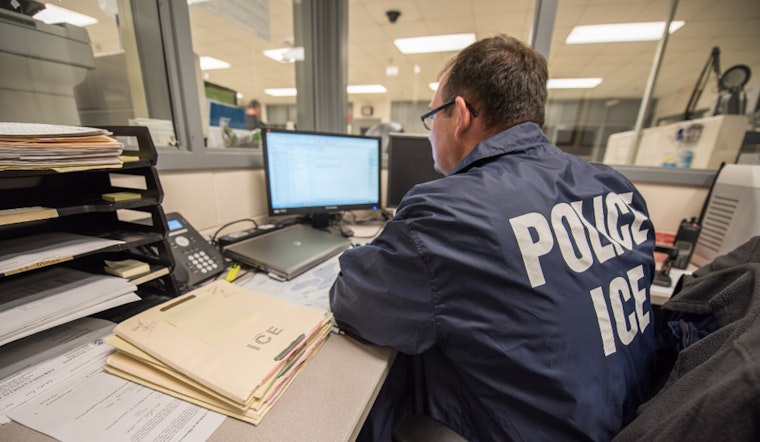
Immigration and Customs Enforcement has launched a nationwide "Birth Tourism Initiative," telling investigators to zero in on networks that U.S. officials say help pregnant foreign nationals travel to the United States to give birth so their children obtain American citizenship. The directive instructs Homeland Security Investigations special agents to look for fraud, financial crimes and organized facilitation networks built around those arrangements. The effort slots into a broader enforcement push that the administration has framed as protecting the integrity of immigration and identification systems.
What ICE says it will do
According to Reuters, an internal ICE email circulated on Thursday tells agents to prioritize cases tied to so-called birth tourism and to disrupt any facilitation networks they uncover. The email stated, "HIS is advancing efforts to protect the integrity of U.S. immigration and identification systems," and directed agents to hunt for fraud and financial crimes linked to maternity travel. Despite the sweeping scope, agency officials have not issued a public press release announcing the initiative.
Visa rules already curb "birth tourism"
Federal officials are not starting from scratch. In 2020, the State Department put into place a rule that allows consular officers to deny B-1/B-2 visitor visas when the primary purpose of travel appears to be obtaining U.S. citizenship by giving birth. That final rule, published in the Federal Register, creates a rebuttable presumption that applicants likely to give birth during their stay are traveling for that purpose and gives officers discretion to refuse visas on that ground.
High-court backdrop
The timing is not accidental. The enforcement push comes as the Supreme Court last week heard oral arguments on President Trump’s executive order that sought to limit birthright citizenship, with lower-court blocks on the order still in place while the justices weigh the issue. As AP reported, the hearing has sharpened political attention on birthright rules and on arguments that the promise of citizenship has encouraged facilitation schemes.
How common is it?
Estimates of how many women travel to the United States primarily to give birth are all over the map. The Center for Immigration Studies and other analysts have put the figure in the tens of thousands in a given year. Later academic re-analyses have revised those estimates, with some placing the range at roughly 20,000-26,000; one such reassessment is reviewed in PLOS Global Public Health. For context, provisional data from the National Center for Health Statistics show about 3,606,400 births nationwide in 2025, so any birth-tourism subset would be a small fraction of total births (NCHS).
Past prosecutions and enforcement
Federal prosecutors have gone after this before. In one high-profile 2019 case in Southern California, operators of so-called "birth houses" and related networks pleaded guilty and received prison sentences for running maternity-service operations that catered to foreign nationals. The new ICE email indicates that the initiative is intended to surface similar facilitation networks so they can be referred for disruption or prosecution. Reuters reviewed the internal directive along with those earlier cases.
Legal tools and potential charges
Under federal law, making a material misrepresentation to obtain a visa or admission can render a person inadmissible and can also open the door to criminal charges. The core provisions are collected in 8 U.S.C. § 1182, which addresses misrepresentation and inadmissibility; see Justia for the statutory text. Those sections and related fraud statutes can be used in prosecutions where investigators say they have evidence of orchestrated visa fraud, conspiracy or money-laundering tied to a commercial facilitation business.
What to watch next: whether Homeland Security Investigations converts the internal directive into actual arrests or indictments, whether consular posts further tighten screening for pregnant visa applicants, and how the Supreme Court’s eventual ruling on birthright citizenship reshapes enforcement priorities and public debate. For now, the initiative signals a renewed federal focus on rooting out commercial operations that prosecutors argue exploit visa rules and hospital systems.





.jpg)