

























































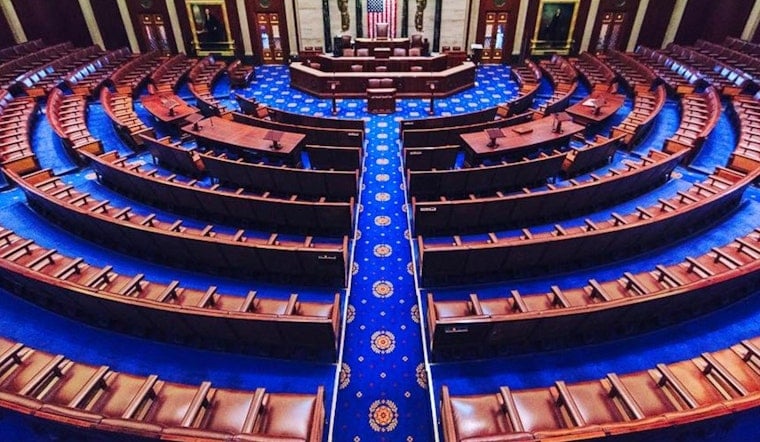
House Democrats muscled a major voting rights bill through the chamber on a narrow 219-212 vote, reviving a legislative fight over federal oversight of state election laws that has simmered since the Supreme Court gutted the original Voting Rights Act more than a decade ago. Every Republican who voted opposed it. The measure now heads to a Senate where its future looks bleak.
The John Lewis Voting Rights Advancement Act, named for the late Georgia congressman and civil rights icon who died in 2020, would restore a form of federal preclearance requiring certain states and jurisdictions to get approval from Washington before changing their voting laws, according to tampabay28.com. Republicans in the House opposed the bill and, per the same report, characterized it as a power grab. Senate Republicans do not have enough votes to overcome opposition to the bill, leaving its prospects dim in the upper chamber.
Why Federal Preclearance Disappeared
The bill is designed to replace a coverage formula the U.S. Supreme Court struck down in the 2013 case Shelby County v. Holder, when the justices ruled 5-4 that applying a 1964 standard to determine which states needed federal approval for election changes was unconstitutional under current conditions, according to the U.S. Department of Justice. Preclearance itself was not struck down — only the formula that triggered it, leaving Section 5 unenforceable without a new congressional standard. Under the new bill, a state would face mandatory federal preclearance if 15 or more voting rights violations occurred within its jurisdiction over a 25-year lookback period, or just 10 violations if committed by state-level officials, according to The Guardian.
The legal landscape has only grown more restrictive for voting rights litigation since Shelby County. In 2021, the Supreme Court ruled 6-3 in Brnovich v. Democratic National Committee to uphold two Arizona election rules, establishing narrower guideposts for evaluating vote-denial claims under Section 2 of the Voting Rights Act, as detailed by the Harvard Law Review. That decision made it harder for plaintiffs to challenge restrictions like out-of-precinct ballot rules and ballot collection limits.
A Familiar Roadblock in the Senate
This is not the first time House Democrats have sent this legislation toward a Senate wall. In January 2022, Senate Democrats failed to pass an earlier version of the John Lewis Voting Rights Advancement Act after falling short of the 60 votes needed to overcome a Republican filibuster, and a subsequent push to change Senate filibuster rules failed 52-48, according to Courthouse News Service. Democratic Senators Joe Manchin and Kyrsten Sinema had joined all 50 Republicans in opposing the rules change at the time. House Democrats are again urging Senate Democrats to change chamber rules to pass the bill by a simple majority if they cannot secure 10 Republican votes, per tampabay28.com.
The bill's namesake carries a weight of prior bipartisan consensus that today's gridlock lacks. Congress previously reauthorized Section 5 of the Voting Rights Act four times with overwhelming bipartisan majorities, signed into law by Republican Presidents Richard Nixon, Gerald Ford, Ronald Reagan, and George W. Bush, most recently in 2006 for a 25-year extension that passed 98-0 in the Senate and 390-33 in the House, according to Ballotpedia.
The Case for Renewed Oversight
Advocates for the bill point to extensive documentation of ongoing discrimination as justification for restoring federal oversight. A 25-year study by the Lawyers' Committee for Civil Rights Under Law documented 340 instances between 1994 and 2019 in which federal courts or the Justice Department made official findings of racial discrimination in voting, according to testimony presented to the House Judiciary Committee. Voting rights advocates have also noted that multiple states swiftly enacted restrictive voting legislation after the Shelby County ruling, including strict photo ID mandates, voter roll purges, and polling place closures — Texas, for instance, announced a strict voter photo ID requirement within 24 hours of the 2013 decision, as reported by Truthout.
The House vote came the same day Democrats advanced the president's $3.5 trillion budget plan, per tampabay28.com. At a voting-rights rally near the White House, Laquita Howard, who is affiliated with the League of Women Voters, was among those present, according to an Associated Press photo caption carried in the tampabay28.com report.
State Legislatures Step Into the Gap
With federal preclearance stalled in Congress, civil rights groups and state lawmakers have increasingly shifted their focus to state-level fixes. In Georgia, state lawmakers introduced the Henry McNeal Turner Voting Rights Act in February to establish state-level preclearance mechanisms for local jurisdictions, a move Hoodline covered in its report, Georgia Democrats Unveil State Voting Rights Act. Similar state-level measures have surfaced in California and Oregon, including a push detailed in Hoodline's earlier coverage, Oregon senators back federal bill.
The stakes for local election maps have only intensified since the Supreme Court's April ruling in Louisiana v. Callais, which tightened standards under Section 2 for creating majority-minority electoral districts and prompted municipal governments, including Los Angeles, to review their local redistricting maps. That ruling and its ripple effects were the focus of Hoodline's coverage in LA Council Orders Map Review.





