

























































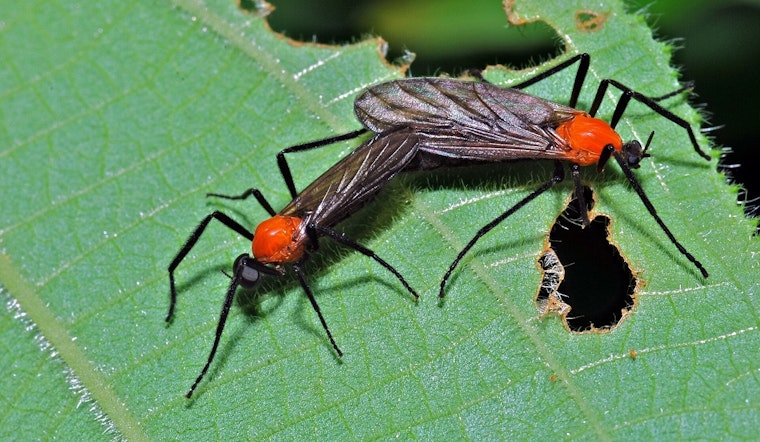
Houston commuters are driving through a cloud of romance this week, and it is not exactly poetic. Small black-and-red pairs of lovebugs have been swarming across the metro area, clinging to windshields, clogging wipers and turning rush hour into a sticky, low-visibility grind. From Pearland to the Inner Loop, drivers are sharing photos of hoods and windshields plastered with mating pairs. For entomologists, it is a predictable, if messy, surge in Plecia nearctica’s short but intense mating cycle.
Chronicle coverage and local reports
On April 8, the Houston Chronicle pulled together a field report that captured just how bad it has been for people on the roads. Commuters described some stretches as “war zones” after hitting dense pockets of insects, with images and social posts showing cars coated in splatter and windshield wipers that could not keep up. The scene-by-scene accounts were documented by the Houston Chronicle.
What lovebugs are and how they behave
Despite the nickname, lovebugs are actually small flies, not true bugs. Adults of Plecia nearctica often mate while in flight and remain attached for several days, which is why they look like tiny insects glued together in midair. In Texas, the species typically produces two generations each year, and the adult phase usually lasts only three to five days. That pattern means numbers can spike almost overnight, then vanish just as quickly. According to the Texas A&M Forest Service, the size of any given emergence depends on weather conditions and natural population cycles.
Why your car looks like a polka-dotted hood
Researchers say lovebugs seem to treat highways like a nightclub with a flashing sign. Sun-warmed vehicle exhaust and light-colored surfaces act as powerful attractants, similar to the cues the insects use to find decaying plant material where females lay their eggs. When flights are heavy, the resulting collisions can briefly cut down visibility, clog radiator fins and leave behind a slightly acidic residue that can etch paint if it sits for more than a few days. Extension specialists recommend washing off splatter promptly, adding a screen in front of the radiator and, during especially intense seasons, using a light film of baby oil on the hood to make cleanup easier, according to the University of Florida IFAS Extension.
Short-lived, messy and actually useful
For all the aggravation on the road, lovebugs do play a role in the ecosystem. Their larvae feed on decaying vegetation, which helps break down plant litter and recycle organic material back into the soil. Adults also visit flowers and contribute to pollination. Population booms are typically held in check by natural forces like weather shifts, fungi and predators, so the big flights tend to rise, crest and fade on their own. As the Texas A&M Forest Service notes, outbreaks do not happen every single year, and their timing changes with local conditions.
How Houstonians are responding
Online, the mood swings between grossed out and oddly sentimental. Social feeds and neighborhood threads are full of photos, complaints and a little bit of “here we go again” nostalgia. Some residents shrug it off as a seasonal rite of passage, while others urge drivers to slow down, protect their paint and park under cover when possible. One citywide Reddit thread described a stretch south of Pearland as a “war zone,” echoing the same battle-weary language used in formal coverage. Those posts and photos are collected on Reddit.
What drivers should expect
Drivers are more likely dealing with a short, intense wave than a season-long siege. Texas usually sees major lovebug flights in spring and again in late summer, although the exact timing and severity shift with rainfall and temperature. For now, the practical advice is simple: ease off the speed in heavy swarms, avoid letting splatter bake on painted surfaces and get cars washed within a couple of days after a major hit. For on-the-ground updates and images from this latest burst, check the coverage in the Houston Chronicle.





_(Bibionidae)_(6782832257).jpg)