

























































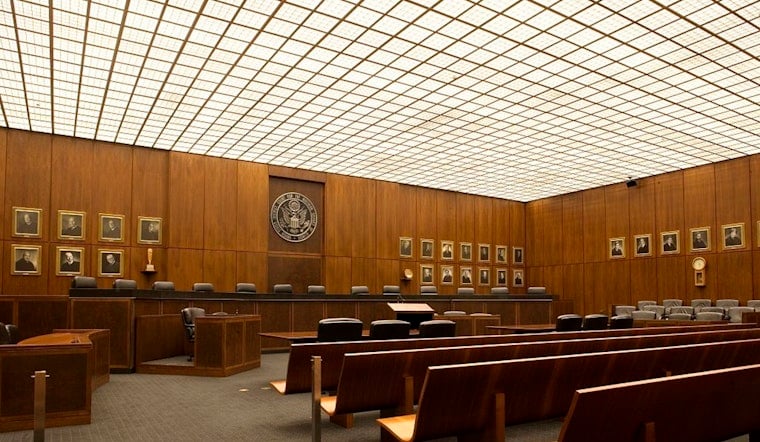
Lawyers for imprisoned former Illinois House Speaker Mike Madigan tried to chip away at his corruption case in front of a three-judge panel of the U.S. Court of Appeals for the Seventh Circuit on Thursday, urging judges to toss his conviction from last year. They argued prosecutors stretched federal bribery and fraud laws past their limits and leaned on a "stream of benefits" theory instead of proving an explicit quid pro quo. Madigan, who is serving a 7½-year sentence, was not in the courtroom. He listened in remotely while his attorneys pushed for either a full reversal or at least a new trial.
Appellate arguments at the Dirksen courthouse
According to CBS Chicago, each side got 20 minutes to argue, with the hearing set for 2 p.m. The panel took the matter under advisement, with no immediate decision. CBS quoted legal analyst Irv Miller noting that appellate judges review the evidence "in the light most favorable to the prosecution," a posture that makes it tough to overturn jury verdicts for lack of proof. Madigan's attorneys told the court the trial judge was wrong to let jurors consider a "stream of benefits" theory instead of requiring proof that Madigan agreed to take specific official action in exchange for something of value.
Conviction, sentence and custody
A federal jury convicted Madigan in February 2025 on 10 counts after a four-month trial, and U.S. District Judge John Robert Blakey sentenced him in June to 7½ years in prison and a $2.5 million fine, according to AP. The jury acquitted him on seven charges and deadlocked on six others. Madigan reported to a minimum-security federal prison camp in Morgantown, West Virginia, in October 2025.
Allegations at the center of the case
Prosecutors told jurors that Madigan conspired with utilities and others, including schemes tied to Commonwealth Edison and AT&T, to arrange no-show jobs, steer business to allies and pressure developers to hire his law firm, local reporting has documented. The alleged ComEd scheme involved subcontractor payments that prosecutors say went to Madigan's allies even when the work was nominal. Those themes combined into the government's portrait of a years-long corruption network, as reported by WTTW.
What the appeal asks the court to do
In a 71-page brief filed last year, Madigan's lawyers said prosecutors "shoehorned nearly a decade of conduct" into overlapping corruption theories and argued that Judge Blakey made several legal errors at trial, according to CBS Chicago. Court records list the appeal as No. 25-2249 before the 7th U.S. Circuit Court of Appeals, per Justia. The defense is asking the panel to reverse the convictions outright or, at a minimum, order a new trial.
Why the appeals court matters
Madigan's team is leaning on a recent run of Supreme Court decisions that narrowed the reach of federal corruption statutes. The Court's 2024 ruling in Snyder v. United States, described by Cornell Law School, limited how gratuities and bribery can be prosecuted under certain federal laws. That precedent gives appellate counsel a fresh set of legal hooks to argue that routine political back-and-forth was improperly labeled criminal at Madigan's trial.
Next steps
The three-judge panel heard argument Thursday but issued no ruling. The judges will now deliberate and release a written opinion, a process that can stretch for weeks or months and is tracked on the public docket. If the 7th Circuit finds reversible legal error, it could vacate the convictions or send the case back for a new trial. If it affirms, Madigan could ask the U.S. Supreme Court to step in. Separately, Madigan has a pending clemency request at the White House that would make the appeal moot if granted, according to reporting by the Chicago Tribune.





