

























































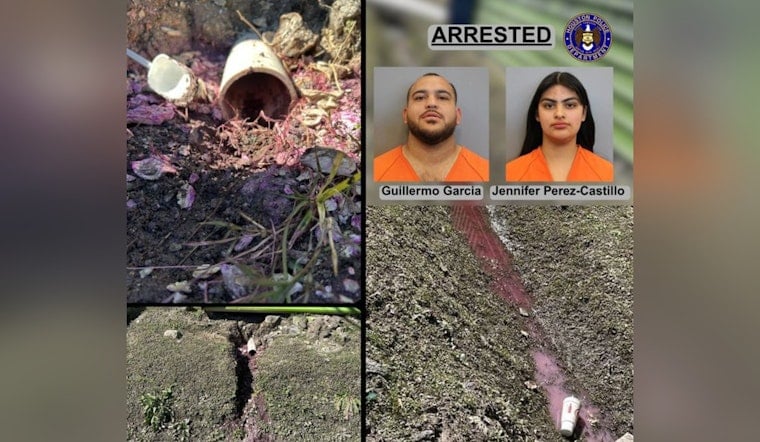
Houston police hauled in two salvage yard owners on Wednesday after investigators said oily runoff and other pollutants were streaming off their unpermitted lot and into storm drains and nearby waterways.
The arrests were made by the Houston Police Department’s Environmental Investigations Squad with backup from the Texas Department of Public Safety. The owners, identified by authorities as Jennifer Perez-Castillo and Guillermo Garcia, were taken into custody following an environmental investigation into alleged illegal discharges from the site, according to police.
HPD’s Environmental Investigations Squad (EIS), along with @TxDPS, arrested two owners of an unpermitted salvage yard accused of illegally discharging pollutants.
— Houston Police (@houstonpolice) April 22, 2026
What Investigators Say
In a post on X, the Houston Police Department said its Environmental Investigations Squad, working with the Texas Department of Public Safety, arrested Perez-Castillo and Garcia in connection with the salvage yard operation, according to the Houston Police Department.
The department described the business as an unpermitted salvage yard and accused it of illegally discharging pollutants. The initial social media post did not list the property’s address, and it did not include formal charging documents or case details beyond the arrests and the allegation of unlawful discharges.
Why Salvage Yards Are Regulated
Auto salvage yards routinely deal with used motor oil, spent batteries, antifreeze and other vehicle fluids that can contaminate soil and stormwater if they are not properly contained. Sites that could send runoff into surface water are often required to obtain stormwater permits and put pollution-prevention plans in place, according to the Texas Commission on Environmental Quality.
The agency offers model stormwater pollution-prevention plans and guidance for businesses that handle used oil, which are intended to help operators keep contaminated runoff out of municipal storm drains and nearby creeks and bayous.
Legal Implications
Under federal law, releasing pollutants into waterways without the proper permit can bring both civil and criminal enforcement. Unpermitted discharges are prohibited, and violators can face civil penalties and, in more serious or knowing cases, criminal prosecution. Federal cases often move in parallel with state or local enforcement, and penalties are typically scaled to the severity, duration and environmental impact of the violations, according to EPA guidance on Clean Water Act enforcement.
Local Context
HPD’s Environmental Investigations Squad has been down this road before. The unit has brought a string of pollution and used-oil cases in the Houston area in recent years, with some investigations ending in state charges and cleanup orders.
Previously, an east Houston oil slick on Buffalo Bayou led to a felony water-pollution charge against a local business owner, a case detailed in Buffalo Bayou oil slick coverage. Local reporters have also followed salvage yard enforcement and alleged violations under the Texas Used Oil Act, as seen in reporting by Click2Houston.





