

























































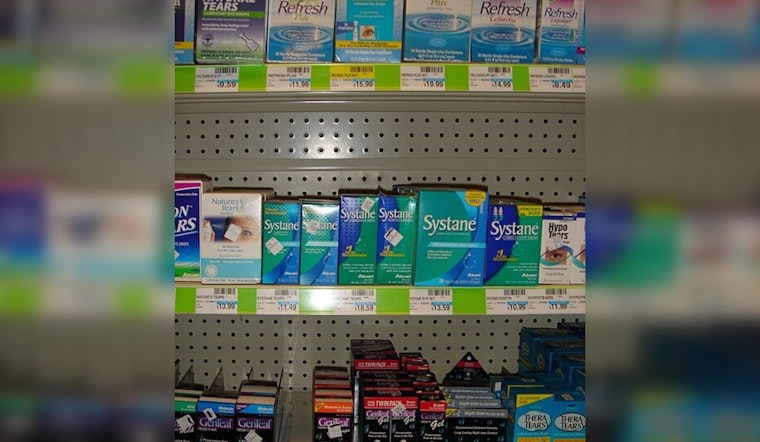
A Pomona drugmaker is at the center of a nationwide eye drop scare after federal inspectors said the company could not guarantee its products were sterile. K.C. Pharmaceuticals has voluntarily pulled more than 3.1 million bottles of over-the-counter eye drops off shelves across the country, covering dozens of stores and generic brands, after regulators flagged sterility concerns.
The recall, which federal officials formally classified this week, hits 26 retail labels and major chains that range from CVS and Walgreens to Kroger and H‑E‑B, and it stretches into military exchanges and national distributors. As reported by FOX 11 Los Angeles, shoppers are being urged to check their medicine cabinets for bottles with lot codes beginning with AC, AR, LT, SU, RG, RL, SY, or AT and expiration dates that run into mid-2026. Health officials say they have not confirmed any clusters of infections, but they still want consumers to stop using affected bottles until they can verify the lot numbers.
What Was Recalled
According to an enforcement report by the U.S. Food and Drug Administration, K.C. Pharmaceuticals listed 3,111,072 bottles across multiple product groupings and voluntarily categorized the move as a Class II recall on Tuesday. The report breaks out the numbers by label: Dry Eye Relief (1,024,000 bottles), Artificial Tears and sterile lubricant formulations (590,000), Original Formula sterile eye drops (378,000), Redness-lubricant drops (315,000), Advanced Relief (303,000), Ultra Lubricating (245,000), Sterile Eye Drops AC (182,000), and Soothing Tears (74,000).
Most of these are private-label products that shoppers recognize by the store name on the box rather than the manufacturer in Pomona, which helps explain how a single factory issue can ripple across so many brands in one shot.
What To Do If You Bought These Drops
Health officials say anyone who finds a matching lot code should stop using the product immediately. Hold on to the bottle and the packaging so you can return it or request a refund, and then check with the retailer about its specific return policy, per FOX 11.
If you notice eye pain, redness, discharge, or any change in your vision after using one of these drops, seek medical care right away and make sure to tell the clinician that you used a product included in the recall. That detail can help doctors decide how aggressively to treat a possible infection.
Why Regulators Are Concerned
The current recall did not come out of nowhere. Federal inspections in 2023 found problems with K.C. Pharmaceuticals' aseptic filling lines, cleaning validation, and quality-unit oversight. Those shortcomings were laid out in an FDA warning letter that said the Pomona plant's manufacturing practices did not meet current good manufacturing practice standards.
That earlier inspection record helps explain why regulators are treating this as a sterility assurance problem that cuts across many private-label brands and distributors. When the system that is supposed to keep bacteria out of eye products is not fully trusted, a lot of bottles end up on the recall list.





