

























































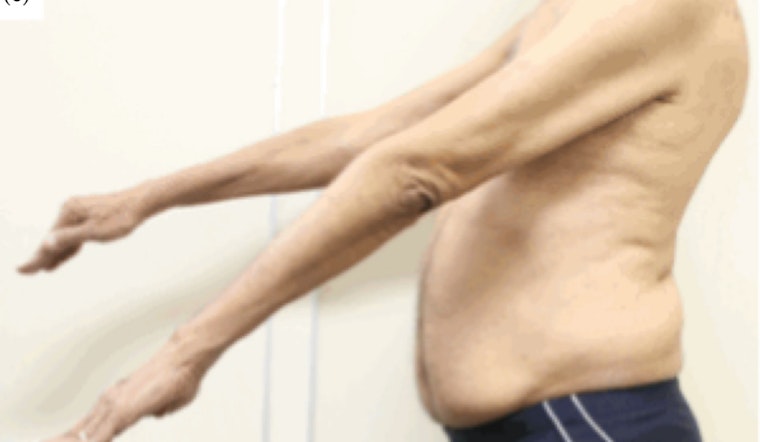
A rare muscle disease has turned 62-year-old Portland veteran Greg Rathburn into a quadriplegic who depends on a ventilator and an electric wheelchair, but he is still fighting the federal agency that controls his benefits.
Rathburn, diagnosed with inclusion body myositis in 2008, spent 21 years in the Air Force and Air National Guard as an avionics technician on advanced aircraft including the SR-71 Blackbird. He first applied for VA disability benefits in 2009, was denied in 2015, and filed a new claim in early April 2026.
What Is Inclusion Body Myositis?
Inclusion body myositis (IBM) is a slowly progressive muscle-wasting disease that typically starts with weakness in the hands and upper legs and often leads to difficulty swallowing. There is no cure, and most therapies offer only limited benefit.
The National Institute of Neurological Disorders and Stroke notes that IBM usually appears in people over 50 and that diagnosis is frequently delayed because symptoms creep in so gradually.
Why Veterans Say It Looks Different
Veterans and advocates say IBM shows up in military populations at higher rates than in civilians and point to data drawn from VA records as evidence that something is off.
A 2025 analysis of VA electronic records identified 732 veterans with IBM and found markedly worse survival in that group, according to a study in Military Medical Research. Advocacy groups and lawyers who work on veterans’ claims have highlighted those findings and individual case histories while urging the VA to give IBM the same presumptive treatment the department applies to ALS, per The Myositis Association.
VA Response And What The Agency Says
Rathburn and other veterans say the VA has repeatedly denied claims that link IBM to service, and Rathburn’s 2015 denial is one example of that pattern, as reported by KGW.
The VA says it continues to evaluate the condition and that benefits decisions require a demonstrated connection between a veteran’s diagnosis and military service. The department’s benefits pages outline the need for a current diagnosis, evidence of an in-service event or exposure, and a medical nexus linking the two. VA describes those evidentiary requirements for non-presumptive claims.
National Academies Review Could Change How Claims Are Judged
The VA has asked the National Academies to review scientific evidence about selected military exposures and a group of neurodegenerative outcomes, and that review explicitly includes inclusion body myositis.
The National Academies committee has begun public meetings and has scheduled veterans listening sessions this spring, and the agency’s Federal Register notice explains that VA will evaluate the Academies’ findings to determine whether formal evaluations and new presumptions of service connection are warranted. National Academies and the VA’s Federal Register lay out the study and public-comment plans.
What Veterans Should Know About Filing And Appeals
For conditions that are not yet presumptive, veterans still have to assemble medical evidence and, often, expert opinions to establish a nexus to service. The VA explains eligibility, filing options, and Fully Developed Claim procedures on its website.
Veterans with slow-onset illnesses such as IBM frequently rely on VA examiners, private specialist opinions, veterans service officers, or attorneys when pursuing supplemental claims or appeals.
For Rathburn and his wife Lori, who retired early to become his full-time caregiver, the stakes are immediate: a service-connection decision affects access to medical care, caregiver supports, and monthly compensation. The National Academies review and the VA’s evaluation of its findings could reshape where IBM sits on the list of presumptive conditions, but for now veterans like Rathburn say they will keep pressing claims and appeals as they wait for the science and policy to catch up, as reported by KGW.





