

























































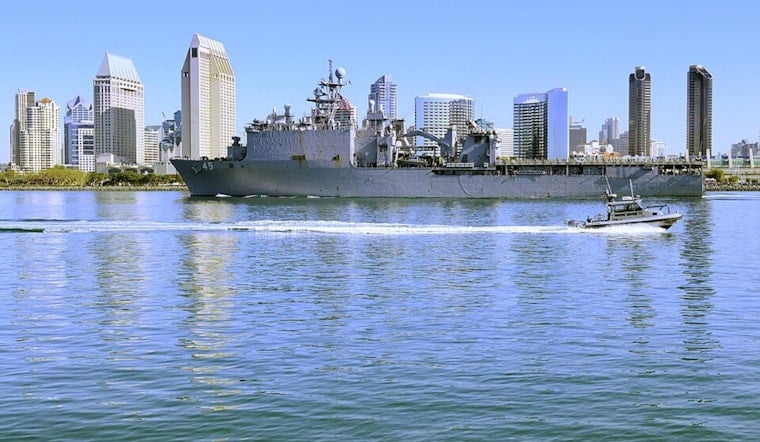
San Diego is fast becoming the Navy’s real-world lab for a new fleet of unmanned “ghost ships,” small, fast sea drones that planners say could help carrier strike groups see farther, stay on station longer and keep sailors out of harm’s way. This month the service ran a series of demonstrations and drills around the region that officials describe as an early preview of how strike groups might operate in the Indo-Pacific.
The push is centered around the city’s vast waterfront, home to the largest Navy complex on the West Coast, where local labs, shipyards and contractors are turning out everything from 16-foot modular craft to larger unmanned hulls, as reported by the Honolulu Star-Advertiser. Developers told reporters they are focused on low-cost, reconfigurable platforms that can handle missions such as mine detection, maritime surveillance and even weapons launches. City and industry officials say San Diego’s dense cluster of Navy infrastructure and technical talent is helping push prototypes from whiteboard concepts to sea trials at unusual speed.
At defense conferences and during recent field events, Navy leaders have been unusually direct about their plans to integrate unmanned surface vessels alongside crewed ships. Military Sealift Command has already demonstrated astern refueling with a Medium Unmanned Surface Vessel, and planners have signaled that sea drones are expected to operate with the USS Theodore Roosevelt strike group in coming years, according to USNI News. Officials say the goal is persistent surveillance and new attack or reconnaissance options without placing sailors directly in the line of fire.
Sea Hunter set the precedent
The basic idea is not new. DARPA’s Sea Hunter prototype, a 132-foot trimaran tested off California, showed that long-endurance unmanned ships could function effectively and at a far lower operating cost than traditional warships. Defense Department reporting from the Sea Hunter christening cited projected operating costs of roughly 15,000 to 20,000 dollars per day for the unmanned trimaran compared with about 700,000 dollars per day for a manned destroyer, a price gap that helps explain the Navy’s urge to scale up uncrewed vessels. Defense Department coverage said the prototype cost about 23 million dollars to build and validated its endurance and autonomy concepts.
Local industry and secrecy
In briefings with reporters, Navy and industry officials keep circling back to the modular nature of the new boats. Some teams are experimenting with 16-foot platforms that can be rapidly refitted for different missions and that, if the program scales, could cost under 1 million dollars apiece, the Honolulu Star-Advertiser reports. Capt. Tim Hawkins, a San Diego-based program officer, told reporters that the Navy will not publicly discuss every platform it is testing “for operational security,” a reminder that much of the experimentation is happening behind the curtain.
The service has also reshaped its personnel structure to match the machines. In 2024 the Navy created a Robotics Warfare Specialist enlisted rating to train sailors to operate and maintain unmanned systems, a change documented by the service’s public affairs office. Navy.mil describes the new rating as the foundation for building an enlisted workforce dedicated specifically to autonomy and unmanned operations.
Officials frame the shift in decidedly practical terms. Unmanned boats can patrol for days at a time, work as forward scouts or carry weapons, all at a fraction of the cost and risk of sailing a crewed ship into contested waters. Analysts and Navy speakers at recent events say the strategy builds on lessons from recent conflicts where cheap, expendable drones have scrambled the maritime risk calculus, and it helps explain the service’s push to buy and experiment with large numbers of small unmanned surface vessels. USNI News reports that planners expect dozens of Medium Unmanned Surface Vessels in the Indo-Pacific by 2030 and thousands of smaller boats over time.
For San Diego, the ghost-ship boom is a classic double-edged opportunity. It promises contracts and highly skilled jobs in software, sensors and small-craft production, while also forcing local leaders to wrestle with export controls, rules of engagement and how to regulate armed autonomous boats operating off their shores. For now, though, the region’s shipyards and engineering shops are busy, and the “ghost ships” that once sounded like science fiction are sliding quickly into everyday Navy business.





_departs_San_Diego_Bay_for_a_scheduled_2011_western_Pacific_Ocean_deployment.jpg)