

























































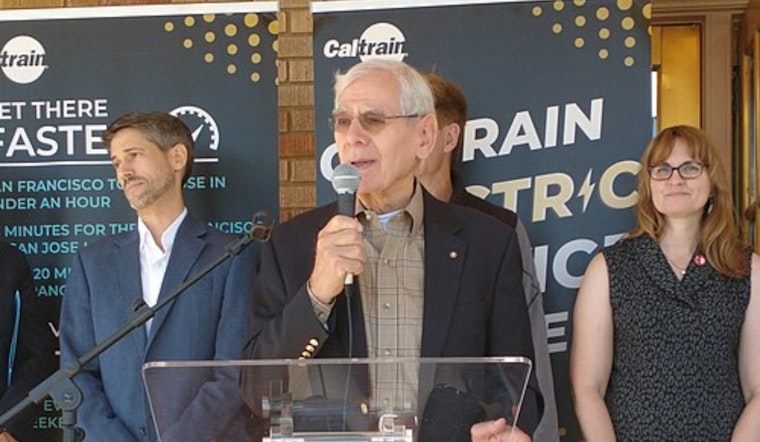
Rod Diridon Sr., the onetime Santa Clara County supervisor often called the “father of modern” South Bay transit, died yesterday at 87. For more than five decades, he championed projects that reshaped how commuters move across Silicon Valley, from light rail to regional rail expansions, mixing political savvy, technical know-how and relentless organizing in a region where transit fights can get famously complicated.
Local officials and family said Diridon died from complications of cancer, and the San Jose Mercury News reported he later developed sepsis following a January radiation treatment, according to the San Francisco Chronicle. The Santa Clara Valley Transportation Authority mourned him as a visionary, saying in a post that “for more than 50 years, Rod advocated for expanded, equitable transit, helping shape the systems our communities depend on today.”
Diridon’s public life stretched from a Saratoga City Council seat in the 1970s to two decades on the Santa Clara County Board of Supervisors, where he pushed the county into transit-era funding and projects. He went on to chair the region’s Metropolitan Transportation Commission, the Bay Area Air Quality Management District and the Association of Bay Area Governments, and he founded the Mineta Transportation Institute at San Jose State University to incubate research and policy work on transportation, according to the Mineta Transportation Institute.
Station That Bears His Name
When the downtown depot was refurbished in the early 1990s, the terminal was renamed San Jose Diridon Station in his honor, a visible marker of the influence he wielded on regional rail planning. Caltrain’s history page notes the terminal was rechristened after its 1994 restoration.
“He was one of a kind,” former supervisor Liz Kniss told the Chronicle, calling Diridon more committed to transportation than anyone she had known, and State Sen. Dave Cortese described him as a tireless organizer who urged action on high-speed rail even as he battled illness, per the San Francisco Chronicle. Those remarks underscore how deeply entwined Diridon was with the region’s planning institutions and power brokers.
Diridon was an original member of the California High-Speed Rail board and spent years advocating for Caltrain electrification and broader regional connections, work documented by the Mineta Transportation Institute and national groups such as the US High Speed Rail Association. He also helped shepherd ballot measures and local financing that enabled light-rail expansions and the extension of BART into Santa Clara County.
Diridon is survived by his wife, Dr. Gloria Duffy, two children and grandchildren, according to local reports. Transit agencies and elected officials said memorials and statements would follow as the region reflected on the work of a builder who helped stitch Silicon Valley’s rail networks together, as reported by ABC7 San Francisco.





