

























































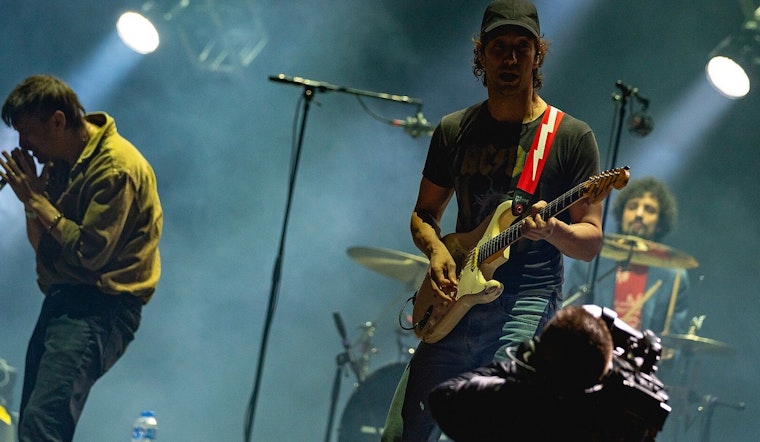
On Coachella's main stage on Saturday night, the Strokes closed their Weekend Two set with a jarring final act that turned the festival's giant LED screens into a crash course in U.S. power and its fallout. As the band played their 2016 track "Oblivius," a blunt political montage accused U.S. foreign policy of backing coups, spliced in images of recent bombings in Iran and Gaza, and flashed captions about schools and universities reduced to rubble. Fans in the field and viewers online were left wondering whether they had just watched a protest piece, a history lesson, or something else entirely.
According to TMZ, the visuals pulled heavily from U.S. history, including references to the slave trade and segregation, and folded in controversial claims about the deaths of figures ranging from Martin Luther King Jr. to leaders in Panama and Ecuador. TMZ also described on-screen text that read "over 30 universities destroyed in Iran" and a clip the outlet said depicted the "last university standing in Gaza" being demolished in what appeared to be a controlled explosion.
Images Named Cold War Coups And Historical Wrongs
Pitchfork reported that the collage explicitly called out figures like Mohammad Mossadegh, Patrice Lumumba and Salvador Allende, framing their ousters as CIA-backed regime changes. The band paired those images with a chorus that repeatedly asks, "What side you standing on?" and observers noted the Strokes had not performed "Oblivius" live since 2016. Stereogum highlighted the setlist choices and the move to unveil the montage on Weekend Two after skipping it the previous weekend.
Onstage Remarks And Viral Clips
Frontman Julian Casablancas did not leave the visuals to do all the talking. As the images rolled, he joked that he had been "tempted to come out tonight with a laptop and show you guys some of those Iran Lego videos" and added, "Land of the free, am I right?" while the band kept playing, according to NBC Philadelphia. NBC reported that clips from the set spread quickly across social media, pointing in particular to the on-screen line claiming that more than 30 universities in Iran have been hit, and to the segment labeled "Last university standing in Gaza," which referenced Al-Israa University.
Fan Reaction Split Across The Field And The Feed
Down in the crowd, the mood was anything but unified. Some fans cheered the band's stance, others looked blindsided that their festival headliner had turned into a crash seminar on geopolitics, as noted by The Independent. The decision to beam such stark footage onto one of Coachella's biggest stages also revived long-standing questions about how far the festival is willing to go as a platform for protest. The Independent reported that neither the Strokes nor Coachella organizers had immediately responded to requests for comment.
Why "Oblivius" Feels Different This Time
"Oblivius" has never exactly been apolitical. Julian Casablancas previously claimed the track's original music video was "shutdown" for being too political, according to a 2016 interview cited by NME. Using it as the closer at Coachella turned those lyrics into something closer to a thesis statement, landing at a moment when the band is gearing up for a new album and tour.
Where It Leaves The Strokes
The move all but guaranteed that the Strokes' Weekend Two set will be replayed, dissected and argued over on timelines and talk shows alike. It also arrives as the band readies a new album, "Reality Awaits," and a summer tour, according to Pitchfork. For now, though, the images are the headline: a prime Coachella slot used to deliver a raw critique of U.S. power, leaving open questions about artistic intent, factual accuracy and where the line sits between festival spectacle and full-on political statement.





.jpg)