

























































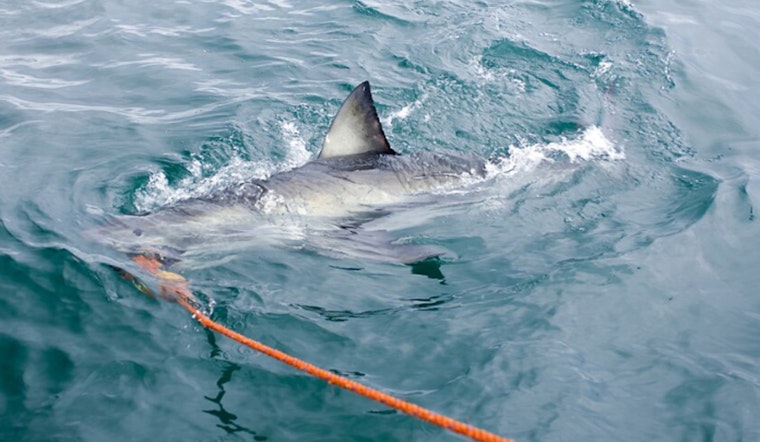
Wednesday morning in Hermosa Beach turned into something out of a surf-town legend when a local fisherman stripped down to his underwear, waded into the breakers, and freed a juvenile great white shark that had been snagged on a fishing line.
The man used a pair of scissors and his bare hands to cut the line, then worked the shark back into deeper water. A small crowd on the sand watched as the animal regained its strength, caught a wave, and swam off, prompting cheers from onlookers.
Resident Alexandra Garry filmed the whole thing on her phone. She said she first noticed two fishermen struggling with what looked like a very heavy catch around 9:20 a.m. As the line came closer to shore, it became clear they had hooked a juvenile great white, and one of the men moved quickly to sever the line and push the shark into a breaking wave, according to the Los Angeles Times.
A risky hands-on rescue
Video from the scene shows the rescuer stepping into the surf, cutting the taut fishing line with scissors, and rolling the struggling shark in the shallows. He then grabs the tail and gives it a final shove into a crashing wave, where the shark rights itself and swims free.
Chris Lowe, director of the Cal State Long Beach Shark Lab, said unseasonably warm Southern California waters combined with an evolving El Niño pattern are likely to bring more sharks in close this year. He told the Los Angeles Times he is expecting “a sharky summer.” Lowe is listed as the Shark Lab director by Cal State Long Beach.
Warmer seas are changing the lineup
Scientists have been tracking steady changes in the ocean lineup along the California coast. NOAA Fisheries’ 2025 ocean ecosystem indicators report shows coastal sea surface temperatures have stayed unusually warm in recent months, a pattern that can push prey species and young sharks closer to shore. Those temperature shifts, combined with monitoring of the California Current, have researchers bracing for more inshore shark sightings this season, according to NOAA Fisheries.
What lifeguards and swimmers should know?
L.A. County lifeguards say juvenile white sharks are typically not out hunting humans. Still, a shark that is hooked or harassed can bite defensively, which is why crews take hooked-shark calls seriously, especially near crowded swim zones.
A 2014 case near the Manhattan Beach Pier showed how fast things can go sideways when anglers and swimmers mix. In that incident, a shark on a fishing line bit a swimmer, and officials temporarily closed a stretch of beach while lifeguards conducted extra patrols, according to CBS News.
Research from the Cal State Long Beach Shark Lab has found that juvenile great whites regularly cruise through Southern California surf zones, passing close to surfers and swimmers with little apparent interest in people. The lab’s work is detailed on the university’s site at Cal State Long Beach.
In Hermosa, Wednesday’s rescue ended without injuries to anyone, shark or human. With experts warning of more nearshore encounters this season, beachgoers are urged to give sharks space, alert a lifeguard if one is spotted, and avoid fishing in crowded swimming areas.





_05.jpg)