

























































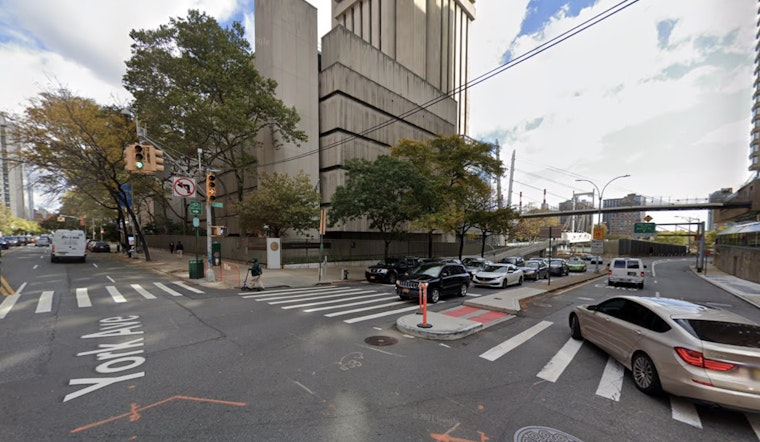
On Oct. 18, 2025, Manhattan mother Emma Thebault was crossing York Avenue at East 63rd Street with her seven‑month‑old baby when, she says, everything went black. A driver ran a red light, shot through a marked crosswalk and plowed into pedestrians. Thebault remembers seeing the car bearing down on them, then losing consciousness. She and her infant survived, but both were injured and left with lingering trauma. Now she is suing the driver and pressing lawmakers to get chronic speeders off New York City streets.
Crash, video and civil case
According to Streetsblog New York City, video of the collision shows driver Inson Dubois Wood making an illegal left turn, racing past cars stopped at the light and accelerating straight into the crosswalk where Thebault was walking with her child. Public records reviewed by the outlet indicate Wood had about 38 speed‑camera violations and roughly 184 prior moving or parking citations, including 23 camera violations in the year leading up to the crash.
Thebault filed a civil suit on Jan. 9 accusing Wood of gross negligence, recklessness and intentional misconduct, and is seeking punitive damages. Her case is built on the argument that the driver’s long record of violations was a flashing warning sign that went largely unanswered.
Repeat tickets and crash risk
City data backs up the idea that some drivers are not just unlucky, they are statistically dangerous. New York City’s NYC DOT Driver Behavior Study found that motorists who rack up more than 20 speed‑camera violations in a single year are about five times more likely to be involved in a crash that causes death or serious injury. The report shows the risk climbing steeply as the number of annual violations rises.
The study charts relative multipliers for killed or seriously injured crashes tied to automated enforcement counts and highlights a small group of extreme repeat offenders who account for an outsized share of high‑risk incidents. Street‑safety advocates say that evidence makes a strong case for focusing on those drivers with targeted measures that prevent them from reaching dangerous speeds in the first place.
Where Albany stands
State lawmakers and safety groups are rallying behind the Stop Super Speeders Act, a proposal that would force the worst offenders to slow down whether they want to or not. Under the bill, drivers who hit specific thresholds, such as 16 or more speed‑camera tickets in a year or 11 license points within 18 months, would be required to install intelligent speed assistance devices, according to a press release from the bill’s sponsor.
The State Senate has already tucked a version of the measure into its one‑house budget, and advocates are pressing the Assembly to move on it before the session wraps. Gov. Kathy Hochul’s New York State State of the State materials also describe a pilot program that would allow New York City to require ISA systems for persistent speeders, a sign that the executive branch is open to a more aggressive, targeted strategy.
Why fines have not stopped repeat offenders
Advocates note that the city’s Dangerous Vehicle Abatement Program, pitched as a way to sideline the most dangerous drivers, quietly expired in October 2023 after limited enforcement and few vehicle impoundments. That left fines as the main tool for dealing with even the most prolific speed‑camera offenders.
Reporting at the time found the program led to only a small number of vehicle seizures despite tens of thousands of camera violations across the city, critics said, a gap that looks even starker in light of cases like Thebault’s. Those shortcomings are a key reason families and street‑safety groups are now pushing for a new pilot that would combine mandatory technology with tougher consequences for drivers who keep racking up violations.
Legal angle
Thebault’s Jan. 9 complaint argues the crash was “no random ‘accident’ but rather the predictable consequence” of Wood’s pattern of speeding, according to Streetsblog New York City. A civil verdict could bring damages for her family and increase political pressure, but advocates stress that only broader system‑level changes, such as speed‑limiter pilots and more robust enforcement, can prevent the same type of driver from injuring someone else down the line.
Thebault’s attorney says the video of the crash and Wood’s extensive public record of violations are central pieces of evidence in the case.
What happens next
Because Stop Super Speeders language is already sitting in budget documents and Albany’s legislative session is still in motion, supporters say the next few weeks could determine whether the pilot program gets funded. The Senate has included the language in its one‑house proposal; now attention is on the Assembly to decide whether to follow suit.
If lawmakers sign off, state and city agencies would still need to sort out how the technology is installed, how compliance is enforced and what privacy protections are put in place before any devices are actually required on private vehicles.
For Thebault, though, the clock is already ticking. She argues that fines and tickets did nothing to rein in a driver whose behavior kept escalating, and she wants the system rewritten so that other families are not left standing in a crosswalk with nothing but luck between them and a known speeder.


