

























































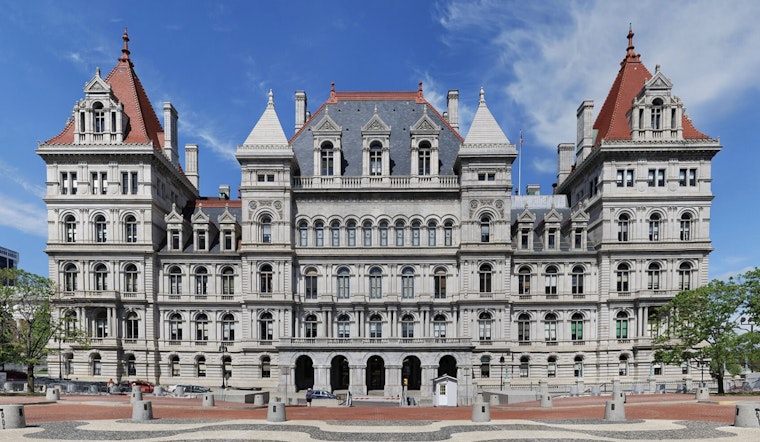
Hundreds of housing advocates, tenant leaders and Democratic lawmakers converged on the New York State Capitol in Albany on Tuesday, pressing for a trio of tenant-protection bills intended to slow evictions and expand legal help for renters. The rally zeroed in on a proposed winter eviction moratorium, a statewide right to counsel and the so-called Clean Hands Act, which would block eviction suits from landlords who have not fixed hazardous conditions. Organizers said they timed the push to put pressure on lawmakers before key budget and committee deadlines hit.
The event was led by the Right to Counsel NY coalition, which laid out the package and its rationale in testimony to lawmakers, arguing that the measures would reduce displacements and save lives, according to the coalition’s testimony to the Legislature, available through the Right to Counsel Coalition. The group spotlighted three bills — S9090/A10121, S6772/A4669 and S4098/A1621 — that together would pause certain winter evictions, create a statewide Office of Civil Representation for tenants and prevent eviction suits from landlords with open housing-code violations. Organizers framed the effort as part of sustained pressure to reshape housing courts and curb eviction-driven homelessness.
What the bills would do
Winter eviction moratorium
S9090/A10121 would prohibit the execution of residential eviction warrants between November 1 and April 15 and would automatically stay pending, unexecuted warrants during that period, while preserving landlords’ right to collect rent at the legal rate, as laid out in the bill text on the New York State Senate website. Supporters say that type of pause could cut down on cold-weather homelessness and give renters and landlords time to secure rental assistance, try mediation or work out repayment plans. A fact sheet from the Community Service Society outlines the public-health risks that backers cite in arguing for a seasonal moratorium.
Statewide right to counsel
The statewide right-to-counsel proposal, S6772/A4669, would create a New York State Office of Civil Representation to fund and coordinate free lawyers for eligible tenants, require courts to notify tenants of that right and instruct judges to adjourn trials for at least 30 days when an eligible tenant appears without a lawyer, as described in legislative summaries. Proponents point to New York City’s 2017 right-to-counsel program, which they say significantly reduced evictions and default judgments when courts enforced it and funding was in place. The bills are active in committee, and advocates say a budget commitment will be needed to actually launch the Office. For bill details, see LegiScan.
Clean Hands Act
The Clean Hands Act, S4098/A1621, would prevent landlords from bringing eviction cases against tenants when state, city or local housing-code violations exist in the tenant’s apartment or in common areas, and it would allow courts to dismiss cases filed by landlords who conceal or ignore hazardous conditions, according to bill summaries. Advocates argue that the measure would shift leverage toward tenants and disrupt a pattern in which some owners opt for eviction instead of repairs. A policy brief from the Community Service Society explains how the proposal is intended to work in day-to-day practice.
Speakers at the Albany rally underscored the scale of the problem. The Right to Counsel Coalition’s testimony cites more than 175,000 active eviction cases statewide, nearly 160,000 people experiencing homelessness, close to 850,000 households sued between Jan. 1, 2020 and Dec. 31, 2025, and more than 164,000 eviction suits filed in 2025 alone. The coalition uses those figures to argue that legal representation, targeted pauses on eviction executions and stronger accountability for negligent landlords could sharply reduce filings and displacement. Speakers also said pairing those reforms with rental-assistance funding would amplify the impact.
Tenant leader Bibiana Mancero, who organizers said has faced three separate winter evictions, told the crowd that getting these bills passed is a matter of basic survival. State Sen. Jabari Brisport and Assembly Member Rodneyse Bichotte Hermelyn used particularly sharp language about housing rights and about courts favoring property owners, according to reporting from News10 ABC. Attendees said those personal stories were some of the clearest evidence that policy changes are needed.
Opposition is already on the record. The Business Council of New York State has warned that a winter moratorium could create logistical headaches for owners and the court system and has urged lawmakers to more directly factor in landlord concerns, according to the group’s statement. The Senate bill also includes civil penalties for violations and sets a narrower window in which eviction executions can proceed, trade-offs lawmakers will have to weigh. Organizers and legal-service providers at the rally said that if the bills advance, detailed implementation plans and strong oversight would be essential.
Where it goes from here
Lawmakers still need to move the measures through committee and sort out costs before any final votes. Advocates are pushing for the statewide right-to-counsel plan to be funded at roughly $260 million in order to stand up the new Office of Civil Representation. That funding figure, and the testimony behind it, came up repeatedly during recent budget proceedings before the New York State Assembly. With committee calendars and the state budget clock both in play, advocates say the next several weeks will determine whether the bills get a path to a floor vote. Lawmakers have not yet set vote dates and say details, especially funding levels and enforcement mechanisms, are still being negotiated.
Advocates argue that the three bills — the winter moratorium, the Clean Hands Act and universal right to counsel — together would change courtroom dynamics and give families crucial time to find help. Whether that vision becomes law now depends on what happens in committee rooms and budget talks in Albany. For more on the bills and the rally, see the coverage from News10 ABC.





