

























































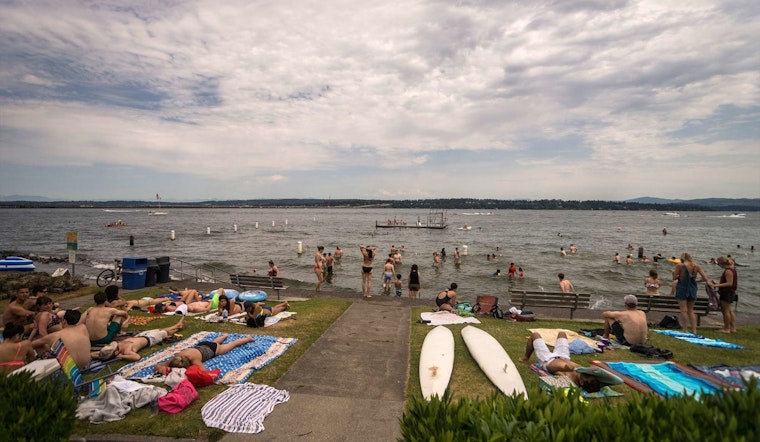
Three popular King County swimming spots are off-limits this week after routine lake testing turned up a serious spike in bacteria levels.
On Monday, county crews pulled water samples that flagged Madison Park Beach, the swim area at Seward Park's Andrews Bay and Renton's Gene Coulon Beach. One Gene Coulon sample came back at about 14,000 colony-forming units per 100 milliliters, nearly 44 times higher than the county's contamination cutoff of 320 CFU.
Public Health Seattle & King County announced the closures based on those results and urged people and pets to stay out of the water at all three sites. The agency collects multiple samples from different parts of each beach so officials can pinpoint where contamination is showing up and decide whether to shut a swim area down.
Monday's readings included Madison Park Beach with roughly 1,900, 2,900 and 2,000 CFU, Gene Coulon with 860 and 14,000 CFU, and the Seward Park Andrews Bay swim area with 1,200, 690 and 680 CFU, according to KIRO 7. Officials have posted closure notices at the affected beaches and are advising against swimming or letting pets enter the water. There is no timeline yet for when the closures might be lifted, per the same report.
What the numbers mean
Public Health uses a single indicator bacterium to signal the presence of fecal contamination and to estimate how likely swimmers are to get sick. Under the county's testing protocol, a beach is generally considered contaminated if two or three samples taken on the same day exceed 320 CFU per 100 milliliters. That threshold and the sampling rules are detailed by Public Health Seattle & King County.
Where to swim and how to get alerts
Other public swim areas are still open, including Madrona Beach, Magnuson Beach, Meydenbauer Beach and Luther Burbank Beach, according to KIRO 7. Public Health encourages swimmers to check the county's beach-bacteria map and sign up for lake-beach alerts before heading out to the water.
What happens next
When bacteria levels spike and closures go into effect, county staff typically run follow-up tests and coordinate with parks crews and local sewage utilities to track and fix possible sources of contamination. Once new fecal inputs stop, bacteria in the water usually disperse on their own, according to The Seattle Times.




