

























































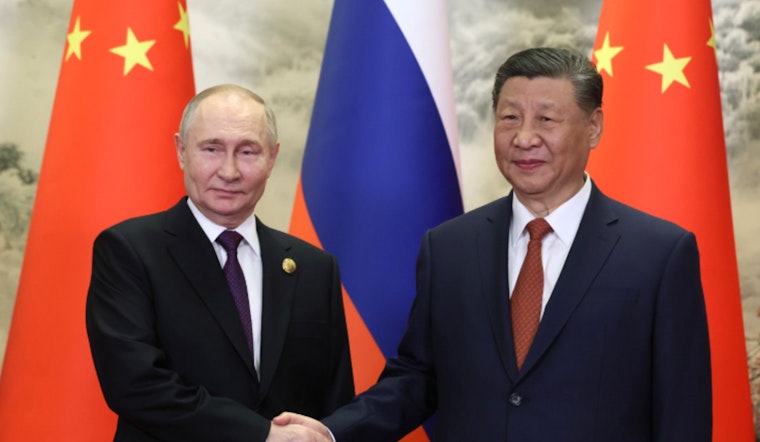
Chinese leader Xi Jinping hosted Russian President Vladimir Putin in Beijing on Wednesday with full honors at the Great Hall of the People, kicking off a tightly choreographed two-day visit meant to showcase how close the two governments have become. Putin's arrival came only days after U.S. President Donald Trump wrapped up his own state trip to the Chinese capital, turning Beijing into the stage for back-to-back great-power diplomacy. The schedule paired high-visibility ceremony - including a formal welcome and tea - with closed-door talks focused on energy, trade and security.
According to The Boston Globe, Xi greeted Putin at the Great Hall before both sides moved into bilateral talks that were set to culminate in signing ceremonies for cooperation agreements. Kremlin aides described the relationship as being at a particularly high level, with ministers and corporate delegations lined up to hammer out commercial details afterward. Beijing cast the visit as part ritual, part business - a public show of political solidarity and a venue to lock in concrete energy and trade arrangements.
Energy and the Treaty
Chinese state media reported that the two sides agreed to extend the Treaty of Good-Neighborliness and Friendly Cooperation first signed in 2001, a symbolic move tied to this year's 25th anniversary of the pact and to a series of planned China-Russia cultural and education exchanges, according to People's Daily. Beijing has promoted the extension as a way to lock in a long-term political framework while ministers continue to negotiate the commercial pieces. Observers note that the legal language is less dramatic than the optics, but it sets a political backdrop for expanding economic ties.
Energy sat at the center of the agenda. Kremlin aide Yury Ushakov told reporters that Russia's oil shipments to China climbed about 35 percent in the first quarter of 2026, a surge Moscow says will speed up pipeline, liquefied natural gas and trading deals, as reported by Anadolu Agency. Putin also hailed recent gains in oil and gas cooperation as a "very substantial step forward," according to China Daily, wording that underscored how both sides are selling the visit as a platform for tangible business outcomes. Delegations said the following days would be used to finalize contracts that could help shield Russian energy income from Western pressure.
Timing and the Message
Analysts say the symbolism is working just as hard as the spreadsheets. "The message is clearly one that China maintains friendship and strategic partnership with whichever power it likes," Steve Tsang told The Boston Globe, while Kremlin aides stressed that Putin's visit had been scheduled well in advance. Russian officials in Beijing repeatedly pushed the line that the trip was agreed only days after a February video call and was not meant as a direct response to Trump's swing through the capital.
President Trump was in Beijing from May 13 to 15, 2026 for his own summit with Xi, a visit the U.S. framed around trade issues and regional stability, as reported by The Washington Post. The back-to-back summits have reinforced Beijing's image as a diplomatic pivot point, capable of hosting rival powers even as it tries to hedge between Washington and Moscow. For U.S. policymakers, the question is whether whatever gets signed in Beijing shifts the leverage Washington can bring to bear on sanctions policy and on Taiwan.
Beyond the pageantry, diplomats and corporate envoys will be watched for hard deliverables, especially in hydrocarbons and in technologies designed to survive sanctions scrutiny. Analysts told RFE/RL that the most immediate result is likely to be a lift in energy revenue for Moscow and deeper commercial links that help Russia ride out Western pressure. For Beijing, the dual summits serve as a live demonstration of diplomatic weight: it can pursue U.S. trade while keeping a strategic partner close on terms that suit Chinese interests.





_2.jpg)