

























































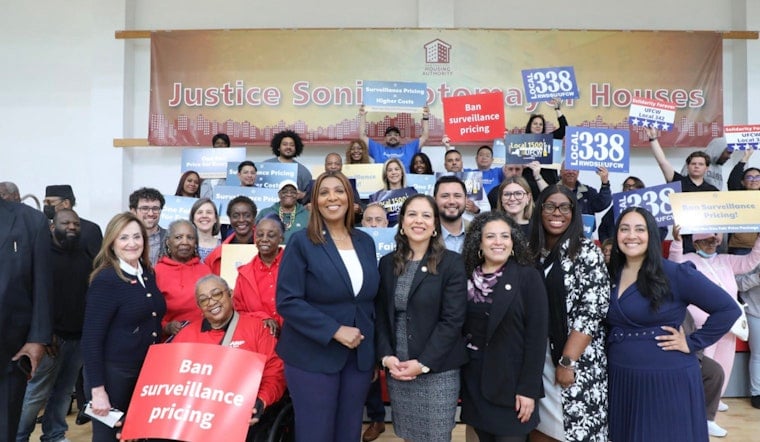
Attorney General Letitia James took the fight over so-called “surveillance pricing” straight to the Bronx on Friday, rallying elected officials, union members and community advocates behind a simple demand: one price on the shelf, the same for everyone at the register.
Inside the Justice Sonia Sotomayor Community Center, protesters hoisted signs declaring “One fair price for everyone” while James and local leaders warned that using shoppers’ personal data to quietly tweak prices person by person crosses a line. Bronx Borough President Vanessa L. Gibson and Assemblymember Emérita Torres joined James on stage, urging Albany lawmakers to crack down on the algorithm-driven price differences.
Standing alongside Attorney General Letitia James and Assembly Member Emerita Torres, we joined elected officials and advocates in calling for an end to surveillance pricing and demanding “one fair price for everyone.” Far too often, consumers are unknowingly charged different prices based on personal data collected online — this practice often happens without consumers' knowledge.
- Vanessa L. Gibson (@vanessalgibson) May 11, 2026
What the One Fair Price package would do
The One Fair Price package wraps two companion bills into a single push to rein in data-driven pricing. The measures would bar companies from using personal or protected consumer data to set individualized prices and would limit the use of electronic shelf labels in large grocery and drug stores.
Supporters say the bills are written to keep everyday loyalty discounts and coupons in place while blocking opaque algorithmic price discrimination. According to the Attorney General’s office, the legislation would also arm the state with tools to seek penalties and restitution from companies that rely on surveillance pricing tactics. Office of the New York State Attorney General.
Bronx turnout and supporters
Local coverage noted that the May 8 event in Soundview drew city council members, labor leaders and community groups who argued that surveillance pricing hits low-income shoppers hardest. News 12 Brooklyn reported that unions including RWDSU and advocacy groups such as AARP New York stood with James and Bronx officials on stage. Organizers said the proposed changes would protect both shoppers and grocery workers from rapid, hard-to-track price swings driven by back-end algorithms and digital tagging technology.
Federal pressure and state models
Advocates are also pointing to mounting federal interest. In 2024, the Federal Trade Commission issued 6(b) orders to intermediaries that sell surveillance-pricing tools and continues to study how those systems use consumer data. The inquiry is meant to shed light on who is supplying the data and pricing engines behind those individualized offers. Federal Trade Commission.
On the state front, Maryland recently moved to limit similar tactics in grocery stores - a step that backers now cite as a template for New York lawmakers. The law is scheduled to take effect this fall. The Guardian reports that supporters there framed it as a first line of defense against data-fueled price games in the middle of a cost-of-living crunch.
Legal implications
One of the companion bills, the Protecting Consumers and Jobs from Discriminatory Pricing Act (A.9396), would open the door to injunctive relief, restitution and civil penalties, and it explicitly authorizes the attorney general to issue subpoenas and bring enforcement actions. Courts could impose fines of up to $10,000 for each violation and award damages in appropriate cases. According to Assembly bill A.9396 as posted by the New York State Senate, the legislation would also create a consumer-and-worker protection fund, fueled by penalties, to support enforcement and remedies.
Supporters argue those enforcement powers are needed to deter hidden, data-driven price discrimination while preserving ordinary promotions and loyalty programs. The Office of the New York State Attorney General has described the package as targeting predatory practices without banning legitimate discounts.
With Albany’s legislative session still in motion, backers say they will keep pressing for floor votes before lawmakers adjourn, even as industry groups warn that the proposals raise tough questions about compliance and carveouts. For Bronx shoppers, the standoff boils down to this: is algorithmic price-testing a helpful modernization at the checkout, or a stealth surcharge layered onto an affordability crisis, and will the state step in to make “one fair price” the rule?



