

























































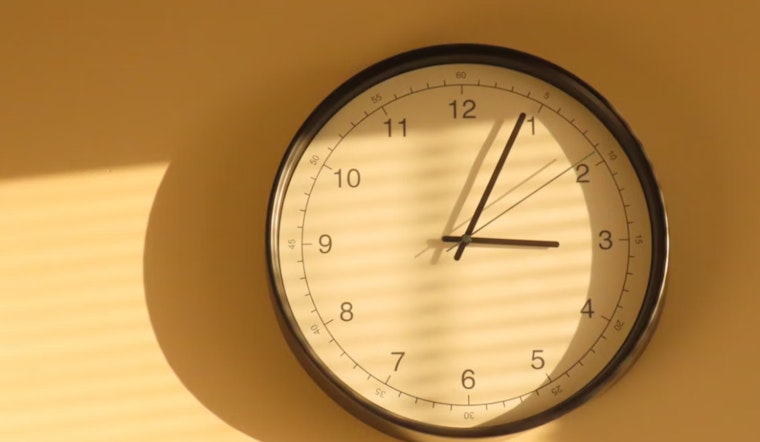
Congress is once again arguing about your alarm clock. House Republicans are reviving a long‑running push to end the twice‑yearly clock change by tucking language from the Sunshine Protection Act into a broader transportation reauthorization package, setting up a possible committee vote this week. The plan would let states choose year‑round daylight saving time, effectively scrapping the familiar “spring forward / fall back” ritual for any state that opts in.
If committee leaders keep that language in the bill and the full House takes it up, the fight over permanent daylight saving time could be back on the front burner in Washington.
Congress has been here before. The Senate actually passed the Sunshine Protection Act in March 2022, but the measure died in the House and never became law, according to Congress.gov. That quick Senate passage showed how fast the issue can move in the upper chamber, but states still cannot flip to year‑round daylight saving time without a federal green light.
Committee Moves To Fold Bill Into Transit Package
The House Energy and Commerce Committee plans to bolt Sunshine Protection Act language onto a surface‑transportation reauthorization and vote on it this week, as reported by The Washington Post. Committee staff told the paper that the panel held hearings and reviewed testimony arguing that extra evening daylight can boost retail activity and might reduce some highway risks.
Not everyone is sold. Lawmakers from inland and northern districts have pushed back, warning that later winter sunrises would leave many commuters and schoolchildren heading out in the dark.
Voters are just as split on the details as their representatives. A YouGov survey in March 2026 found that roughly two‑thirds of adults, about 64 percent, want to stop changing clocks twice a year. Once you ask what the new permanent time should be, the consensus falls apart. Forty‑three percent favored year‑round daylight saving time, while 28 percent preferred permanent standard time, according to YouGov.
Health And Safety Arguments Cut Both Ways
Supporters of permanent daylight saving time point to more evening light for shoppers, outdoor activities, and potentially safer evening commutes. Doctors and sleep researchers caution that there is a catch. The American Academy of Sleep Medicine has said that ending the biannual clock change is a good idea, but argues that permanent standard time lines up better with human circadian rhythms, according to its guidance.
Researchers have also documented short‑term bumps in cardiac events and traffic incidents around the spring transition to daylight saving time, though large national studies have produced mixed results, including a recent analysis in JAMA Network Open.
State Readiness And Legal Limits
Plenty of states are already poised to act if Congress loosens the rules. The National Conference of State Legislatures reports that 19 states have passed laws or resolutions that would allow them to adopt year‑round daylight saving time once federal law allows it. For now, though, federal statute still decides whether states can stay on daylight saving time all year.
Some places have taken the opposite route and simply skip daylight saving time altogether. Hawaii and most of Arizona already observe standard time all year, according to the NCSL and NIST.
A Short Memory Of The 1970s Experiment
There is also a history lesson lurking in the background. During the 1974 energy crisis, the United States briefly tried permanent daylight saving time. The experiment did not last. Within a year, lawmakers reversed course after widespread complaints about dark winter mornings and safety concerns for schoolchildren. Opponents of today’s plan cite that episode often as a cautionary tale.
That memory helps explain why some lawmakers are wary of a single national approach and why the choice between brighter evenings and darker mornings remains politically touchy.
How the committee handles the issue this week will show whether Republican leaders are ready to force that decision now. For everyone else, the stakes are simple enough: if Congress acts, the twice‑a‑year clock change could finally end, but whether the country lands on permanent daylight saving time or permanent standard time will be shaped as much by politics as by polling or science.



