

























































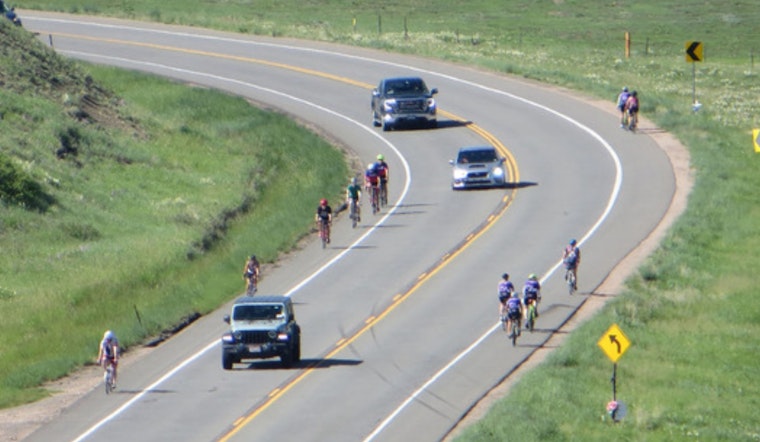
Cyclists who white-knuckle it along the skinny shoulder of U.S. 36 between North Boulder and Lyons may finally get some breathing room. Boulder County is sketching out designs for an 11‑mile separated bikeway that would pull riders off the narrow, traffic‑hugging edge of the highway and onto a dedicated path.
The concept calls for a mostly 12‑foot‑wide concrete path set about 20 to 30 feet from the highway where there is room, with retaining walls, railings, and raised crossings in tighter pinch points. Officials estimate the project could cost roughly $95 million and be built in phases, although final engineering and funding are still very much works in progress. County staff says public input gathered at recent open houses and online surveys will help determine which alignment and crossings move ahead.
According to Boulder County, the design phase is open for community feedback this spring through an online survey and public meetings. The county’s Transportation Planning Division says that outreach will shape the detailed engineering, which must account for private driveways, transit stops, and protections for natural resources along the corridor. Staff is also recruiting a community advisory committee to help steer the next phase of work.
County data show a troubling safety record on this stretch of highway. Officials tracked 13 injuries and six deaths between 2015 and 2024, and locals recently reported a serious hit‑and‑run crash that left a rider badly hurt. "There’s no separation between highway traffic and cyclists," said Alexandra Phillips, Boulder County’s bike planner, explaining why the county is pushing for a fully separated facility. That reporting and the county numbers were summarized by the Denver Gazette.
The project’s 2024 feasibility work found that a 12‑foot‑wide bikeway within CDOT right‑of‑way is technically feasible and would run about 11 miles from Broadway in North Boulder to CO 66 in Lyons. A CDOT loop counter near milepost 32 recorded 78,581 riders in 2020, and the study pegs overall construction costs at about $95.65 million, much of which planners hope to cover with federal grants. Because of steep, uneven terrain, several segments would need extensive retaining walls, guardrails, and railings, and would require more detailed engineering. As outlined in the Boulder County feasibility study, the east‑side alignment makes the best use of existing CDOT right‑of‑way and limits new land impacts.
Pinned Focus Areas Offer Tradeoffs
Planners have zeroed in on four especially tricky sections along the corridor: the south end near Broadway, the Neva Road access, Left Hand Canyon, and the CO 66 junction near Lyons. In each spot, design choices range from modest tweaks to full‑blown new crossings, with very different implications for cost and comfort.
At the south end near Broadway, options include a new underpass or a west‑side crossing that would route riders along Old Broadway. At Neva Road, the team weighed either an overpass or a raised crossing. At Left Hand Canyon, the bikeway could slip under an existing bridge or trigger the need for a new traffic signal, depending on how the final engineering pencils out. Each option carries tradeoffs for cost, user experience, and environmental impacts, and officials told the Denver Gazette that these choices are still under review.
Funding, Timeline And Next Steps
Boulder County is chasing federal grants and lining up local match money to cover the bulk of construction, and a contracted engineering study will be required before any final designs are approved. Staff warns that engineering and permitting could take another year or two, and that construction is still years away, likely phased so a mile or two can be built at a time as funding comes through. Public feedback gathered now will be folded into the engineering scope to help the county make a stronger case for grants, according to Boulder County.
If the project moves forward, the separated path is expected to open the scenic U.S. 36 corridor to riders of all skill levels and cut exposure to the high‑speed traffic that has made the road so hazardous. For now, county planners say the work will be slow and iterative as engineers, habitat managers, and grant writers try to thread the needle between building a safe, resilient route and protecting the foothills’ sensitive terrain.




