

























































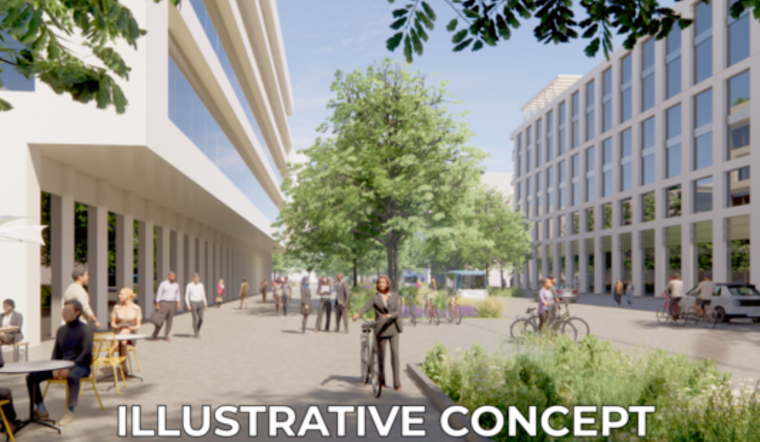
Howard County is rolling out a sweeping remake of the Columbia Gateway Business Park, recasting it as the Gateway Innovation District. The 1,100-acre vision, county officials say, could eventually support as many as 8,100 jobs and roughly 8,400 housing units. The concept blends office and flexible “innovation” space with retail, parks, and new neighborhoods, all pitched as a way to link housing, transit, and training to the employers already lined up along the I-95 corridor. County planners and economic development leaders say the district is aimed at tech, cyber, and defense firms, while also widening local workforce pipelines.
Big numbers, big ambitions
The master plan lays out a set of high-end buildout scenarios: analysts estimate market demand for 5,700 to 8,400 housing units and 4,700 to 8,100 new jobs, along with roughly 1 to 1.8 million square feet of office and innovation or flex space and about 312,000 square feet of retail and restaurants. According to Howard County, those figures represent the upper-range scenario meant to show what the district could support over the long haul. County testimony to the Maryland General Assembly also folds those job and housing targets into its pitch as officials seek state financing tools to help pay for transit and infrastructure upgrades, per the submitted testimony.
Where it sits and who it hopes to serve
The Gateway footprint is edged by I-95, Maryland Route 175, Snowden River Parkway, and the CSX rail corridor. County officials argue that the location puts the district in a prime spot to serve Fort Meade, the National Security Agency, and Johns Hopkins Applied Physics Laboratory. The County Council approved the Gateway Master Plan in October 2025, and County Executive Calvin Ball signed it into law, clearing the way for the next round of zoning work and infrastructure planning. Local coverage and the county portal outline the adopted plan, the consultant studies behind it, and the timeline officials are using as they court developers.
Tradepoint at Savage Crossing offers an early boost
Some of the jobs on the horizon are already tied to specific projects. Tradepoint Atlantic’s Tradepoint at Savage Crossing development on Route 1 is projected to deliver roughly 500 supply-chain and logistics jobs and more than $100 million in private investment, giving the corridor an early shot at employment activity. Tradepoint’s own project page describes a phased buildout of about 500,000 square feet, with a schedule that moves from site preparation into construction over 2026 to 2029. Regional reporting and developer materials say projects like Tradepoint are expected to fill in the area with industrial and logistics activity, even as the county markets Gateway to higher-end office, tech, and cyber tenants.
Workforce programs and financing questions
County officials and leaders at the Howard County Economic Development Authority, or HCEDA, stress that new jobs will not mean much without matching training. HCEDA points to programs such as the Cyber Howard accelerator as part of the talent pipeline, and Howard Community College is adding a trades hub aimed at construction, manufacturing, and skilled-trade roles. HCEDA officials say internships, apprenticeships, and targeted training will be central to connecting residents to the jobs envisioned at Gateway. At the same time, county testimony filed with state lawmakers argues that an Enterprise Zone designation, along with additional financing tools, will be needed to cover the cost of transit, environmental remediation, and public infrastructure at the scale the district will require.
Timeline and next steps
With the plan now adopted, the county has posted supporting fiscal and market analyses and says the rollout will be phased over multiple years, with infrastructure and remediation work expected to precede large housing starts. The master plan package includes high-range fiscal analyses and consultant market studies that county staff say will guide both negotiations with developers and future public investment priorities. Officials are now lining up zoning changes, development agreements, and financing talks that will ultimately decide how quickly any of the headline job and housing numbers become real.
What it could mean for residents
Supporters describe Gateway as a once-in-a-generation opportunity to add housing, jobs, and amenities along a major regional corridor. Some council members and nearby residents, however, have raised concerns about brownfield cleanup, the long-term cost of infrastructure, and where exactly new housing should be concentrated. If the district reaches the high-end projections, Gateway would bring thousands of homes and jobs to the broader Baltimore-Washington region, although that outcome depends on private capital, market conditions, and years of coordinated public investment. For now, county leaders point to near-term projects and existing workforce programs as early signs that the bigger vision can start to take shape.





