

























































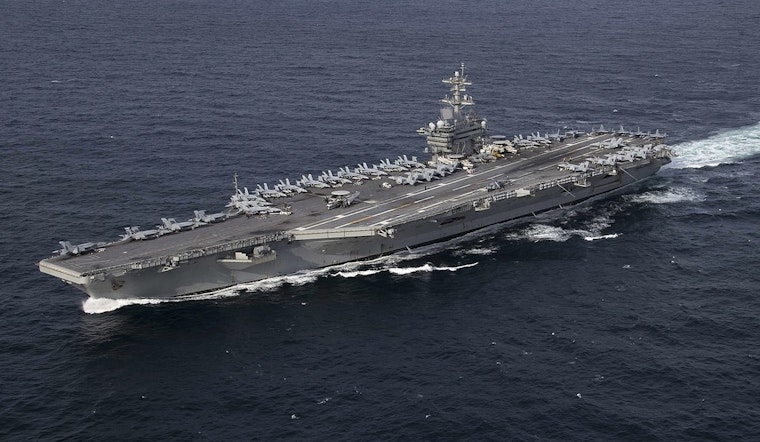
A U.S. Navy jet flying from the carrier USS Abraham Lincoln opened fire on an Iranian-flagged tanker in the Gulf of Oman on Wednesday morning, disabling the ship after what Washington describes as an attempt to run a naval blockade and reach an Iranian port. The strike targeted the vessel’s rudder, leaving it unable to continue toward Iran. U.S. Central Command has identified the ship as the M/T Hasna and says the crew ignored repeated warnings before the jet opened fire.
What U.S. forces say
In a press release via U.S. Central Command, officials said an F/A-18 Super Hornet launched from USS Abraham Lincoln fired "several rounds" from its 20mm cannon into the Hasna’s rudder after the tanker refused orders to stop. CENTCOM put the operation at about 9 a.m. ET and emphasized that "the U.S. blockade against ships attempting to enter or depart Iranian ports remains in full effect." The statement also underlined that "Hasna is no longer transiting to Iran."
Ship details and timing
Local coverage and ship-tracking data describe the Hasna as an unladen tanker of roughly 300 feet that was moving through international waters in the Gulf of Oman, with an Iranian port listed as its destination, according to Times of San Diego. That outlet and CENTCOM both place the incident early Wednesday, around 6 a.m. Pacific time, or 9 a.m. on the East Coast. No immediate crew casualties were reported, and officials are still working out whether the damaged rudder will require a tow or if repairs can be carried out on scene.
Part of a wider blockade
The shot across the Hasna’s bow is only the latest move in a broader naval blockade the United States put in place in mid April. U.S. forces previously seized another Iran-flagged vessel, the M/V Touska, after it brushed off warnings on April 19, as reported by AP. Military outlets including Stars and Stripes and the Navy Times have tracked a pattern of interdictions and radio warnings to ships moving through the Strait of Hormuz and the Gulf of Oman. U.S. officials say the intent is to block shipments of materiel that could feed Tehran’s war effort.
Diplomacy on a knife edge
The timing of the strike is touchy. It landed in the middle of efforts to hammer out a deal that could reopen the Strait of Hormuz, a process already fraught enough that President Donald Trump temporarily paused a U.S. escort mission known as Project Freedom to see whether negotiators can close an agreement, according to Axios. Analysts have warned that hard-edged enforcement at sea risks knocking delicate talks off balance, and energy markets remain jittery over any hint of disruption to traffic through the strait. For now, Washington insists the blockade will stay in place even as diplomacy lurches forward.
What comes next
CENTCOM has reiterated that its forces "continue to act deliberately and professionally to ensure compliance" and that Hasna "is no longer transiting to Iran," repeating language from its written statement. Shipping authorities and maritime safety officials now have to sort out what happens to the crippled tanker, from towing arrangements to custody of the vessel and the welfare of its crew, while diplomats try to keep negotiations from unraveling, a picture reflected in reporting by AP and defense outlets. The episode is a reminder of how quickly a single enforcement action at sea can ripple outward during a fragile ceasefire.





_underway_in_the_Atlantic_Ocean_on_30_January_2019_(190130-N-PW716-1312).JPG)