

























































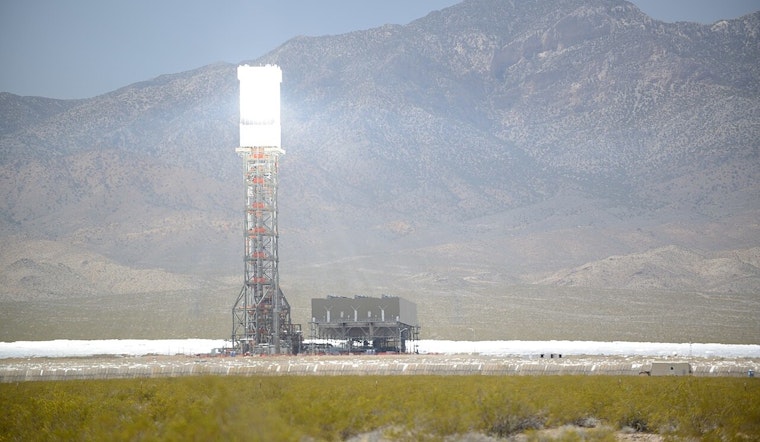
The Ivanpah Solar Electric Generating System, the three-tower field of mirrors in the Mojave Desert just past Primm, is once again under the microscope as regulators, utilities and federal officials argue over who gets stuck with the tab. The $2.2 billion complex, visible to anyone driving I-15 out of Las Vegas, was built as a concentrated solar thermal experiment but has stumbled with lower-than-expected power output and higher operating costs. A deal that would have wound down long-term contracts and shut two of the three units is now on ice, leaving taxpayers and California ratepayers waiting to see where the financial fallout lands.
In January 2025, PG&E asked state regulators to approve termination agreements that would have taken Units 1 and 3 offline in early 2026 and paid the owners to exit their power purchase agreements, as laid out in Advice Letter 7485-E. The California Public Utilities Commission rejected the proposal “without prejudice,” pointing to grid reliability concerns and the risk of stranding hundreds of millions of dollars in transmission investment, according to the CPUC. Details of the proposed buyouts and how PG&E hoped to recover those costs are spelled out in the company’s filing, per PG&E.
Why Regulators Balked
Commission staff warned that signing off on an early shutdown could pull the plug on existing clean generation just as electricity demand is expected to climb. Forecasts point to rising load from new data centers along with the electrification of buildings and vehicles, and regulators said that backdrop made it risky to lose Ivanpah’s capacity right now. They also highlighted the possibility that transmission lines built to serve the project could be marooned as sunk costs. In the commission’s view, those reliability and stranded-asset worries outweighed the near-term savings for ratepayers that utilities argued would follow a shutdown, a trade-off described in reporting by the Los Angeles Times.
Taxpayer Backing And The Federal Loan
Ivanpah was built with substantial federal backing, including a $1.6 billion loan guarantee, and company disclosures show the owners applied for roughly $540 million in Treasury cash-grant proceeds. Because that federal loan has not been fully repaid, the U.S. Department of Energy has taken an active role in talks over any early termination in order to protect taxpayers, according to DOE. Project financing terms and the grant applications are detailed in NRG’s SEC filings.
Performance, Mirrors And Gas Use
The site uses roughly 173,500 heliostat mounts, holding about 347,000 individual mirrors, that concentrate sunlight onto three towers roughly 450 feet tall. On paper, it was meant to showcase a new kind of large-scale clean power. In practice, the plant has produced less electricity than projected, its effective efficiency has been questioned, and operators have at times relied on natural gas to heat boilers for morning startups, according to energy-sector reporting and local coverage. Analysts note that photovoltaic panels paired with batteries have grown far cheaper and more flexible since Ivanpah was conceived, a comparison that has only sharpened criticism of the project’s performance. The mirror and heliostat counts are discussed in analysis on ScienceDirect, while output and loan concerns have been chronicled by E&E News and in local reporting from KSNV.
What Comes Next For The Mojave Towers
Because the CPUC’s rejection came “without prejudice,” the utilities and plant owners can return with revised plans while all three units keep running, according to the commission’s order. Southern California Edison is still negotiating over the contract for Unit 2, and NRG and its partners have publicly floated the idea of repowering the site with cheaper photovoltaic arrays if they can secure financing and regulatory approvals. Company statements and local stories describe that photovoltaic repower as one possible endgame rather than a done deal; those discussions are covered in reporting and operator comments at KNPR.
Regulatory And Legal Fine Print
In its advice letter, PG&E asks the CPUC to let it recover any termination payments through specific portfolio accounts, a technical but crucial choice that affects whether bundled customers ultimately shoulder the buyout costs. Taken together, the CPUC resolution and PG&E’s filing lay out the legal and ratemaking framework that will govern any buyout, repowering plan or phased shutdown. They leave several administrative avenues open, depending on whether the parties can produce a proposal that satisfies reliability requirements and addresses stranded-cost concerns, according to PG&E and the CPUC.
For anyone driving the I-15 corridor, the Ivanpah towers will remain a gleaming Mojave landmark for the foreseeable future, even as the fight over who pays for years of underperformance drags on behind the scenes. For now, federal lenders and the plant’s owners are pushing for one set of outcomes, utilities and some critics are pushing for another, and the CPUC has effectively tossed the question back into a slow-moving regulatory process.




