

























































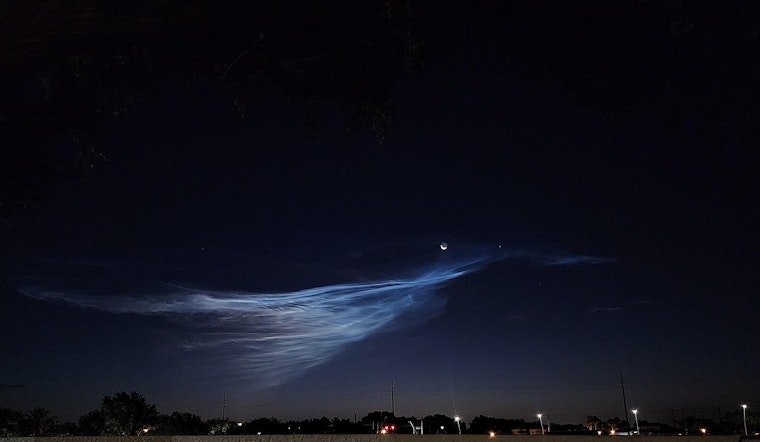
Early risers across Tampa Bay got an unexpected sci-fi wake-up call Thursday morning when a surreal neon-blue cloud drifted over the water, looking uncannily like a glowing jellyfish. The odd formation appeared in the pre-dawn sky around 6:00 a.m., then morphed and stretched as it moved across parts of the bay. Within minutes, photos and videos of the plume were flooding local feeds and neighborhood message boards.
As reported by 10 Tampa Bay, meteorologist Courteney Jacobazzi identified the spectacle as a noctilucent cloud created when rocket exhaust froze into ice crystals and refracted the first light of the rising sun. The station’s coverage and viewer images show the plume shifting shape quickly while holding that striking electric-blue glow along the horizon.
What Launched and When
A SpaceX Falcon 9 lifted off from Cape Canaveral early Thursday as part of a Starlink mission, with launch trackers listing liftoff from Space Launch Complex 40 at just before 6:05 a.m. EDT, per NextSpaceflight. Because the rocket was climbing just before sunrise, its exhaust plume was lit from above while the ground below was still relatively dark, which made the trail visible across much of the Tampa Bay area.
How a ‘Space Jellyfish’ Forms
Noctilucent clouds float in the mesosphere at roughly 50 miles above Earth and are made of tiny ice crystals that can glow when sunlight hits them during twilight. Space.com notes that a rocket’s exhaust can help seed those crystals by adding water vapor and particulates that freeze in the ultra-cold upper atmosphere. The result is the kind of neon-blue, shifting shape that Tampa Bay skywatchers saw early this morning.
Why We See Them More Often
Florida sits directly downrange from Cape Canaveral’s launch corridors, so on clear pre-sunrise mornings residents often get a front-row seat to residual plumes from rockets hundreds of miles away. Scientists are also examining whether a rise in early-morning launches, combined with changes high in the atmosphere, is making noctilucent displays more common, a link discussed in research cited by EarthSky.
If you slept through this morning’s show, local outlets have posted galleries and clips that capture how the cloud evolved over the course of the hour. For those hoping to catch the next one, SpaceX mission pages and other launch tracking sites list upcoming liftoffs and webcasts that could set the stage for another sky spectacle.





