

























































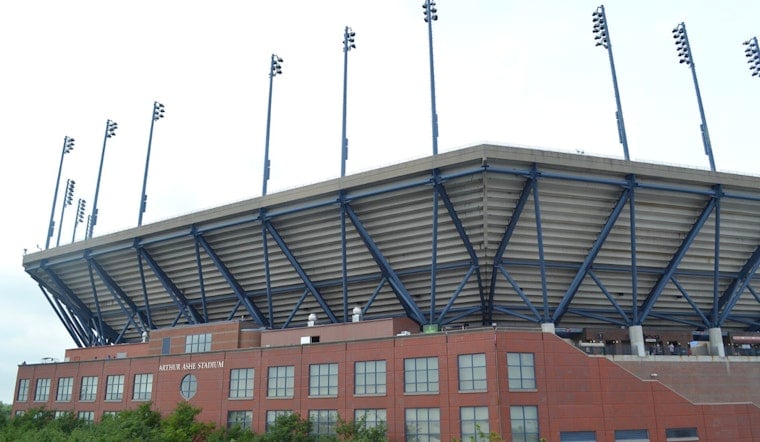
The U.S. Open operator is quietly shopping about $400 million in privately placed debt to help bankroll a multi-year overhaul of Arthur Ashe Stadium, according to reporting on May 19, 2026. The financing would slot into a broader reimagining of the Billie Jean King National Tennis Center that the USTA rolled out last year. Neighbors and advocates in Queens say the pivot toward private credit could reshape who profits from upgrades at one of the borough's biggest venues and who ultimately calls the shots.
As reported by Crain's New York Business, citing Bloomberg, the USTA is marketing roughly $400 million in privately placed notes to institutional credit managers. Sources told Crain's that the planned deal would be pitched directly to private-credit funds instead of going through a public bond sale.
The overhaul itself was unveiled in May 2025 as an approximately $800 million modernization of Arthur Ashe Stadium, a program the USTA at the time described as "entirely self-funded," according to a USTA release. More recent industry coverage and a credit review suggest the true price tag may run higher. SportsBusiness Journal reported that Fitch now pegs total project costs closer to $1.1 billion and expects roughly $850 million of that to be funded with debt.
Parkland, parking and neighborhood stakes
Flushing Meadows residents and community groups have long tracked every tweak at the Tennis Center, in part because construction staging and parking plans lean on city-owned parkland and lots that serve multiple events. Earlier local reporting on lease fights and development near the complex helps explain why new financing moves draw such fast neighborhood scrutiny.
Private credit's moment
Across sports, real estate and media, borrowers have increasingly turned to private-credit managers as banks and public markets rethink how they price risk. Recent Bloomberg coverage of other $400 million private-credit placements shows institutional lenders are still willing to underwrite large, single-asset financings, the same pool of capital the USTA is reportedly courting for Arthur Ashe.
Timeline and what to watch
The USTA's three-phase schedule is set up to keep the show going, with the most visible construction timed around the U.S. Open so play is not interrupted. Spectator-facing upgrades are expected to appear ahead of the 2026 and 2027 tournaments, according to a USTA release and construction reporting in Engineering News-Record. Structural reinforcement began in late 2024, and the association plans to swap out courtside and suite levels in the breaks between U.S. Opens while a new player performance center is scheduled to be in place by 2027. How the roughly $400 million note sale is actually used, whether to speed up interiors, refinance earlier facilities debt, or bolster liquidity during the build, will indicate whether the project stays primarily USTA-funded or leans more heavily on outside lenders.
For Queens, the core question is whether bringing private credit into the mix accelerates the fan-facing promises or simply hands fresh decision-making power to the investors that buy the notes. Market traders and municipal watchers will be focused on the offering terms. Local civic groups will be focused on what that capital means for parkland, parking and how much of the upgraded Tennis Center still feels like public space.





_(9634591916).jpg)