

























































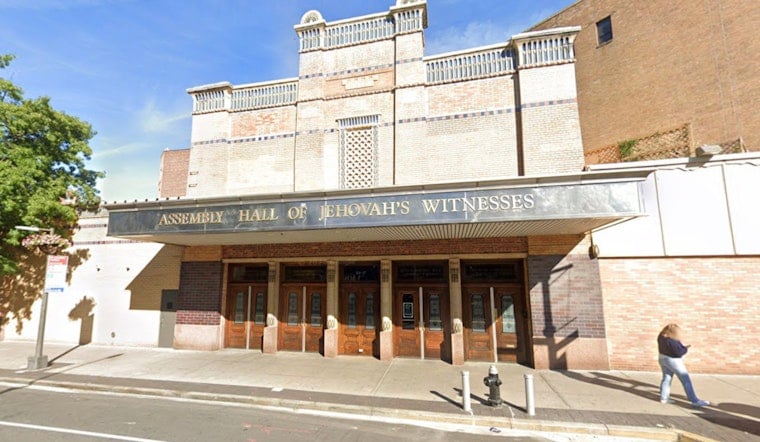
A former Jehovah's Witnesses assembly hall in Sunnyside could soon trade pews for apartments. A developer has filed plans to replace the building at 44-17 Greenpoint Avenue with an 11-story mixed-use project that would bring roughly 145 residential units to the corner of Greenpoint and 44th streets, steps from the 7 train. The proposal is already on the radar of neighbors and local officials as it heads into the city review pipeline.
According to Crain's New York Business, the filing outlines plans for about 145 apartments on the site. A development feed from PincusCo, which reviewed the same city submission, lists the project at roughly 143 units and around 142,593 square feet, with ZD Jasper Realty (ZDJ Greenpoint LLC) named as the applicant. Meridian Capital's offering materials indicate the lot was previously held by the Christian Congregation of Jehovah's Witnesses and sold to a developer in 2024 for about $16.3 million.
Community board scrutiny and zoning questions
Queens Community Board 2 is already probing the proposal. The site appears on the board's February 18 Land Use and Housing Committee agenda under "Bliss Theatre / 44-17 Greenpoint Avenue," with a note to "Clarify Council Member Julie Won’s concerns regarding cultural space." The agenda from Queens Community Board 2 shows members are weighing whether the block should be considered for a denser zoning designation.
Because the proposal would increase height and density beyond the site's current zoning envelope, the project would likely need a zoning change that triggers the city's Uniform Land Use Review Procedure, or ULURP. That public-review process gives the community board and elected officials a formal voice, and it is often where concerns about scale, shadows, and neighborhood character bubble up.
Transit and developer trade-offs
The city filing reviewed by PincusCo notes that the parcel sits inside the Inner Transit Zone. The applicant is not proposing any on-site parking, pointing to the site's proximity to the 7 train and several bus lines. That move lines up with a growing number of transit-adjacent projects where developers lean into higher unit counts instead of carving out space for garages.
On the ground, that trade-off is almost guaranteed to spark debate. For some residents, fewer parking spaces mean a more walkable, transit-focused neighborhood. For others, it raises red flags about curbside competition and whether local streets can handle the extra demand.
Part of a wider pattern
The Sunnyside proposal also fits into a broader citywide pattern: large Jehovah's Witnesses properties being repurposed for housing. Coverage of the Watchtower complex in Brooklyn by NY1 highlights similar fights over upzoning and conversion, where plans to add hundreds of units have stirred questions about affordability and the preservation of cultural or community space.
Given that backdrop, Sunnyside residents and advocates are likely to push hard for clarity on what, if any, community benefits or cultural uses might be baked into the Greenpoint Avenue project as negotiations unfold.
Next steps
If the applicant formally seeks a taller building or denser zoning, the case would move into the ULURP process, starting with Community Board 2 before heading to the Queens borough president, the City Planning Commission, and potentially the City Council. Guidance from NYC notes that ULURP involves public hearings and can take several months from start to finish.
That timeline gives local leaders and neighborhood groups multiple chances to weigh in on everything from building height to affordability before any rezoning is locked in.



