

























































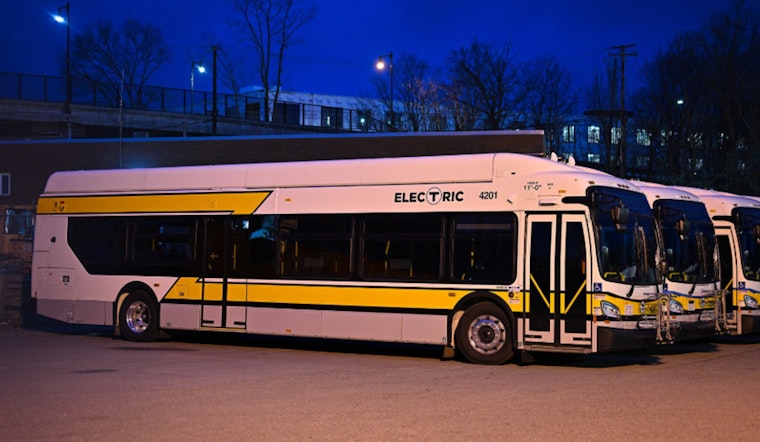
The MBTA is quietly turning two familiar bus yards into high-voltage hubs, getting ready to push large numbers of battery-electric buses onto local routes. In Quincy, a hulking two-story maintenance building near Quincy Adams is taking shape, while in North Cambridge a compact, tightly packed yard is getting a full retrofit. Recent site photos show crews putting in charging gantries, big electrical cabinets and deep maintenance pits so the agency can charge buses overnight and handle heavier repairs in-house instead of shipping vehicles off elsewhere.
As reported by StreetsblogMASS, the outlet toured both garages in April and published a hard-hat photo tour. The piece notes that the Quincy complex covers roughly 300,000 square feet and is designed to house about 120 battery-electric buses, while North Cambridge is being outfitted to support around 32 BEBs under a canopy of chargers. StreetsblogMASS also reports that the T is aiming to bring Quincy online in summer 2027.
Project Budgets and Program Scope
The authority’s own planning documents back up the scale and the price tag. The MBTA’s MBTA FY27-31 Proposed Capital Investment Plan lists an authorized budget of roughly $461.2 million for the Quincy Bus Facility and programs the North Cambridge retrofits at about $44.1 million, with another $7.8 million in supplemental funds. Those line items appear in the MBTA’s project list for bus facility modernization and help explain why these two sites have jumped to the front of the line.
North Cambridge: A Retrofit Testbed
City of Cambridge transit materials and MBTA presentations spell out the technical guts of the North Cambridge project. They describe an overhead gantry of pantographs, plug-in chargers, multiple charging units and new pad-mounted transformers, all squeezed into the existing yard. The documents note that charger testing took place in November 2025 and the work reached substantial completion in December 2025. The MBTA expects the upgraded yard to support an initial fleet of roughly 32 battery-electric buses dispatched out of North Cambridge.
Charging Tests and Teething Problems
According to StreetsblogMASS, the hard-hat tour also caught one early hiccup during a pantograph demonstration. The MBTA told the outlet that "the operator attempted to request the charge sequence when the bus was already at or near a full state of charge," and that "because of this, the battery controller had to be reset before it would accept a charge." The report adds that the T has installed thermal cameras at the charging bays to watch battery temperatures while crews fine-tune the system ahead of revenue service. In other words, the bugs are showing up in testing, not in front of riders.
Quincy: Big Build, Big Power
The Quincy facility is massive on paper and in person. The project’s lead design firm lists the new maintenance building at roughly 350,000 square feet and highlights the heavy-duty charging infrastructure and substation work required to support a 120-bus depot. STV emphasizes sustainability and the electrical capacity built into the design, which also helps explain the high budget figures in the MBTA’s capital plan.
Why This Matters
Electrifying the MBTA’s bus fleet is not just a cool tech upgrade, it is a legal requirement. An advisory board analysis notes that recent state laws require the MBTA to stop buying fossil-fuel buses after December 31, 2030, and to cease operating them after December 31, 2040. That turns garage construction and charger commissioning into a hard deadline rather than a nice-to-have. An MBTA Advisory Board analysis with CLF frames the facilities program as a key constraint on meeting those statutory targets.
What To Watch Next
All signs point to a slow but steady rollout. MBTA project documents show that North Cambridge reached substantial completion late last year and that charger testing is under way, while Quincy remains a multiyear undertaking in the FY27 Capital Investment Plan as the authority lines up final contracts, substation work and system commissioning. Riders should expect battery-electric buses to appear gradually as the T accepts more vehicles and verifies charging safety and reliability at each yard, rather than flipping a giant switch all at once.





