

























































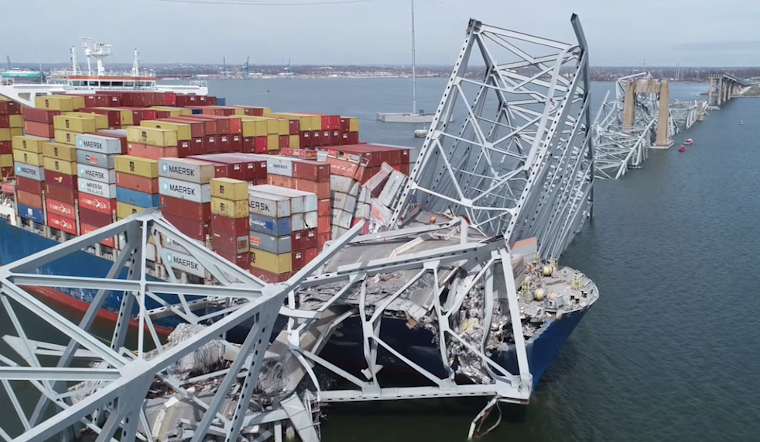
With less than a month to go before a high-stakes federal bench trial over the 2024 collapse of Baltimore’s Francis Scott Key Bridge, lawyers for the M/V Dali’s owner and manager say some of the people who know the most about what happened are too scared to talk. According to filings and recent court arguments, key crewmembers have refused to answer questions, invoked the Fifth Amendment, and are reluctant to travel to the United States at all. That anxiety is already shaping how the parties prepare for a June limitation-of-liability hearing that will decide whether the ship’s owners can cap what they owe at the post-incident value of the vessel and its remaining cargo.
At a recent pretrial conference, attorneys described marathon depositions that stretched to six hours while crew members “invoked the Fifth Amendment in response to the majority, if not virtually all, of substantive questions.” Defense lawyer Tom Belknap told the court that some witnesses are “terrified” they will be subpoenaed or detained if they set foot in the U.S. Instead, civil lawyers decamped to London for weeks to take testimony from seafarers who would not risk coming to Baltimore, and some crewmembers remain tied to the federal process while investigations continue, according to The Daily Record.
What the June bench trial will decide
The month-long bench trial set to begin June 1 is not about who is emotionally sympathetic. It is about whether Grace Ocean Private Ltd. and Synergy Marine Pte Ltd. can use the federal Limitation of Liability Act to cap their civil exposure at the value of the M/V Dali and whatever cargo remained after the allision, a figure the owners peg at roughly $43.6 million. The legal question sounds narrow, but the financial stakes are enormous: if the court grants a limitation, many claimants will be stuck dividing a fixed vessel fund instead of pursuing full damages.
According to a prior memorandum from the U.S. District Court, the judge has already accepted security of about $43.67 million and carved out the limitation issues for this separate trial, while pressing the parties to be fully prepared for the June hearing. The procedural roadmap and schedule are laid out in the U.S. District Court memorandum.
Settlements have already shifted the map
Even before the limitation fight, some of the biggest players have already cut their own deals. In 2024, the U.S. Department of Justice reached a civil settlement with Dali’s owners worth more than $100 million. Maryland officials announced a settlement in principle in April 2026, and insurers have disclosed a $350 million payout to the owner and operator. Those resolutions trim certain routes to recovery even as a long list of private claimants keeps pressing forward.
The settlements do not end the story. Dozens of families, businesses, and public entities still have active claims tied to the bridge collapse and the economic shock that followed, and they are watching the limitation case closely to see how much money will actually be on the table. The state’s announcement and earlier deals were detailed by The Washington Post.
FBI probe and the travel dilemma
Layered on top of the civil battle is a federal criminal investigation that has made international witnesses even more jittery. Federal prosecutors opened a criminal probe shortly after the March 26, 2024, allision, and by mid-April, FBI agents were on board the Dali executing court-authorized searches. That kind of law-enforcement presence onboard a ship tends to travel fast through maritime circles.
Defense attorneys told the court they have seen seafarers served with grand-jury process or otherwise constrained by overlapping criminal proceedings, which has pushed many depositions overseas instead of into a Baltimore conference room. The FBI’s boarding of the vessel and the court-approved search activity were reported by The Maritime Executive.
Legal implications
The Fifth Amendment is playing an unusually visible role in a civil bench trial. In criminal cases, jurors are strictly barred from drawing any negative inference when a defendant refuses to testify. Civil cases operate differently: parties can ask the court to infer that a witness who invoked the Fifth is hiding something damaging. How much weight to give that silence is up to the judge.
U.S. District Judge James K. Bredar has already signaled he will tread carefully. “I’m not a jury. I can’t help that I am who I am,” he told lawyers, adding that he has “seen the Fifth Amendment invoked more times than one could possibly count,” according to The Daily Record. His comments suggest the court plans to sift through the entire record - depositions, documents, and expert testimony - instead of leaning too heavily on broad inferences from witnesses who chose to stay silent.





.jpg)