

























































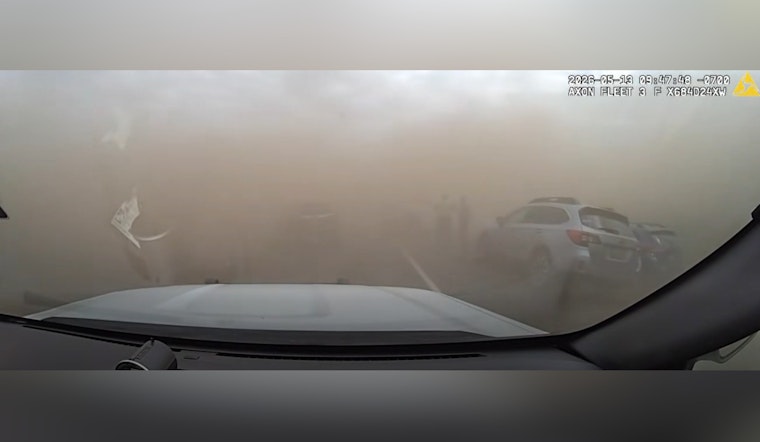
What started as a routine crash response near Spangle last Wednesday turned into a full-on whiteout when troopers from Washington State Patrol's District 4 suddenly found themselves swallowed by a fast-moving dust storm. In a matter of seconds, visibility dropped to nearly zero, drivers lost their bearings, multiple collisions followed, and stretches of U.S. 195 had to be shut down while crews sorted out the mess. Now state agencies are again sounding the alarm about how to stay alive when the horizon just disappears on eastern Washington roads.
In a Facebook post, Washington State Patrol said District 4 troopers "encountered a dust storm that rapidly reduced visibility while assisting at a collision near Spangle." The post laid out step-by-step advice for drivers who suddenly cannot see the pavement in front of them. If you cannot safely leave the roadway, troopers say to ease off the gas, switch on headlights and hazard lights, and tap the horn from time to time. If you can pull all the way off the road, they want you to turn off your lights, set the emergency brake, and sit tight until the air clears. The post ran under the wry headline "now you see him… now you don't" and included the hashtag #yourwsp.
What happened last Wednesday
Earlier that day, the National Weather Service had already raised a red flag. A Dust Storm Warning was issued for southeastern Spokane County as a fast-moving dust channel pushed through the region, kicking up gusts above 50 mph and cutting visibility to less than a quarter mile along parts of U.S. 195, according to National Weather Service Spokane. The warning specifically called out U.S. Highway 195 between mile markers 76 and 84 and urged drivers caught in a wall of dust to pull completely off the road and keep their foot off the brake.
Road closures and emergency response
As conditions deteriorated, state crews and local media reported a string of crashes that shut down U.S. 195 north of Spangle, between Cheney-Spokane Road and Watt Road. A separate collision on I-90 blocked lanes while tow operators worked to clear out damaged vehicles, according to Fox Weather. Traffic-camera shots shared by officials showed a brown curtain of dust marching across the roadway, and authorities urged drivers to steer clear of the area until wreckage and debris could be removed.
How to stay safe when visibility collapses
In the aftermath, both the State Patrol and the National Weather Service doubled down on a simple message: you need a plan before the sky turns beige. If you cannot safely leave the roadway in a sudden dust storm, they advise slowing down, keeping headlights and hazard lights on, and sounding your horn every so often so other drivers know where you are. If it is safe to get completely off the road, the guidance is to kill your lights, set the emergency brake, and wait it out, as Washington State Patrol explained.
The National Weather Service slogan, "PULL ASIDE STAY ALIVE," drives home what sounds obvious but often is not in the panic of zero visibility. Stopping in a travel lane when you cannot see can leave your vehicle practically invisible to oncoming traffic, which creates an extremely dangerous chain-reaction risk, according to National Weather Service Spokane.
Drivers planning trips across eastern Washington are being urged to check real-time conditions from WSDOT before heading out, especially on routes that cut through open farmland and dry streambeds that are prone to kicking up dust. WSDOT travel alerts, along with State Patrol updates on social media, remain the go-to sources for quick information on closures and safety guidance during high-wind events.



