

























































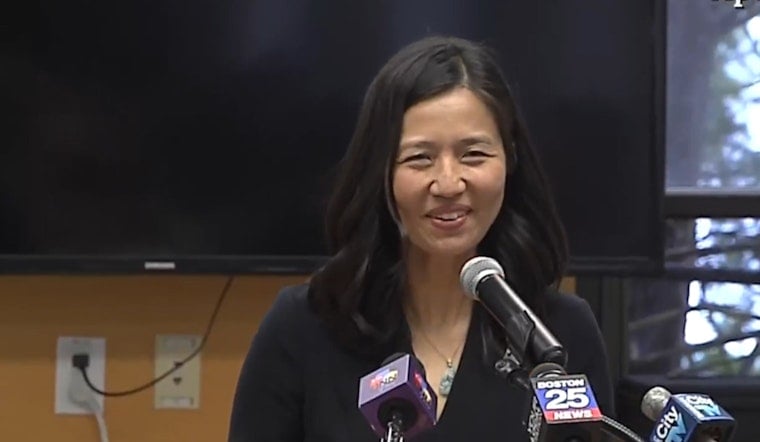
Mayor Michelle Wu used a community gathering in Jamaica Plain to bring back her push for a new tax on Boston’s priciest property deals, signing a home-rule petition that would let the city charge up to a 2 percent transfer fee on the portion of private real-estate sales above $2 million. The money would go to the Neighborhood Housing Trust to build and preserve income-restricted homes and to expand property-tax relief for low-income seniors. The City Council has already signed off on the measure; for it to take effect, the Massachusetts Legislature must approve it and the governor must sign it.
At the event, held inside the long-vacant Blessed Sacrament church, Wu held up the redevelopment underway there as exactly the kind of project the fee is meant to bankroll. As reported by The Boston Globe, she signed the petition on Thursday and told the crowd, “We will continue to try for this. Because we truly need every bit of resources for our community.”
Blessed Sacrament as a concrete example
The Blessed Sacrament project is an adaptive reuse of a 1913 church that developers say will cost more than $40 million to convert into 55 income-restricted apartments plus a multipurpose performance and community room. A project update from Pennrose outlines the scope, timeline, and planned community uses for the site. The BPDA details construction progress and additional program information for the redevelopment.
How much could the fee raise?
City officials have floated some big-dollar projections. According to city data cited by The Boston Globe, a 2 percent fee on the portion of sales above $2 million “would have generated $160 million by now” if it had already been in place.
An independent review underscored how volatile that stream could be. The Boston Municipal Research Bureau estimated that the same 2 percent fee with a $2 million exemption would have brought in about $39.8 million in 2023 and warned that revenue would swing with the market from year to year, according to the BM Research Bureau.
The city’s own materials highlight a different snapshot, noting that applying a 2 percent rate to 2021 sales would have yielded roughly $99.7 million, which helps explain the wide range of estimates in circulation, per Boston.gov.
Statehouse math and politics still matter
Even with Boston’s home-rule petition in hand, nothing happens unless Beacon Hill signs off. The measure has to clear the Massachusetts Legislature and land on the governor’s desk, a high hurdle after earlier transfer-fee efforts stalled. Governor Maura Healey did include a local-option transfer fee in her 2023 Affordable Homes Act proposal, but lawmakers scaled back or removed the idea during negotiations, according to Mass.gov.
Advocates have tracked similar moves outside the city as well. Other communities, most recently Barnstable County, have pursued their own home-rule petitions for transfer fees, as reported by Boston.com.
Where supporters and opponents stand
Supporters argue the fee would create a reliable, locally controlled funding source for projects like Blessed Sacrament at a time when federal and private dollars are harder to nail down. Industry groups and brokers fire back that tacking a surcharge onto high-end sales could spook buyers, slow transactions, and undercut any fragile market recovery, concerns that trade organizations have laid out in detail at public hearings, according to Banker & Tradesman.
On the ground in Jamaica Plain, the Hyde Square Task Force, which sold the Blessed Sacrament property to Pennrose and is slated to operate the new performance space, argues that redevelopment is essential to save the landmark and anchor broader neighborhood investment, as the group explains in its materials on the project from the Hyde Square Task Force.





