

























































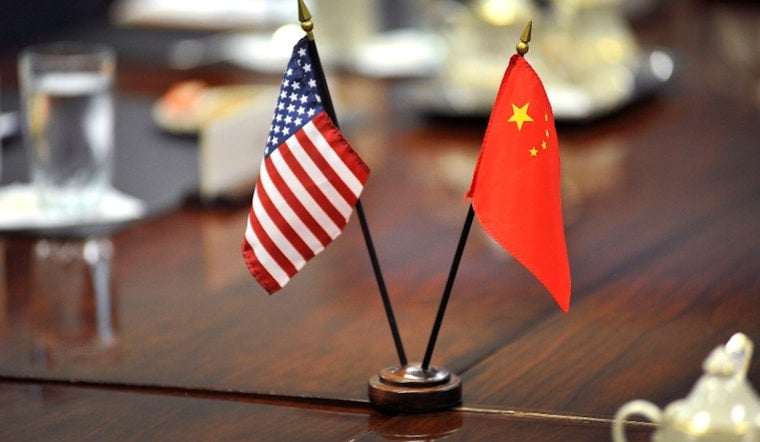
China is tightening the taps on key military-adjacent gear headed to the United States, announcing Monday that it will bar exports of so-called "dual-use" items to 10 American defense contractors. The move, framed as a calibrated response to Washington’s latest tech restrictions, covers components and materials with both civilian and military applications and extends to transfers routed through third countries. Beijing says the curbs are meant to protect national security while leaving a narrow lane open for exceptions that it deems genuinely necessary.
What Beijing put on the table
China’s Commerce Ministry singled out 10 U.S. companies that will no longer be allowed to receive Chinese dual-use exports, zeroing in on drone makers and firms tied to the rare-earths supply chain. The list includes AVEOX (Simi Valley, Calif.), Red Cat Holdings and Teal Drones (South Salt Lake, Utah), IMSAR (Springville, Utah), JAIA Robotics (Bristol, R.I.), Ball Aerospace (Broomfield, Colo.), Oshkosh Defense (Oshkosh, Wis.), L3Harris Maritime Services (Norfolk, Va.), MP Materials (Las Vegas) and USA Rare Earth (Stillwater, Okla.), according to The Associated Press. Officials described the step as a direct response to what they called an improper expansion of a U.S. list targeting Chinese military-related companies.
How the controls will operate
Chinese exporters can still apply for licenses if a shipment is "genuinely necessary," but Beijing has warned that approvals will be rare and closely scrutinized. The ministry also made clear that companies and individuals in third countries are barred from routing China-origin dual-use items to the blacklisted American firms, tying the move to the country’s broader export-control regime. The legal toolkit Beijing cited, anchored in its Unreliable Entity list and export-control rules, gives the Commerce Ministry wide latitude to restrict business and to approve or deny special-use applications, according to MOFCOM.
What prompted Beijing's response
The announcement followed a Pentagon move earlier this month that broadened a U.S. roster of Chinese companies it says are linked to Beijing’s military. That designation limits the Defense Department from signing contracts with the listed firms and this time swept in some of China’s best-known tech names. The step drew a sharp reaction from Chinese officials and helped pave the way for the latest tit-for-tat trade measures. The Washington Post and other outlets detailed the Pentagon’s update and the diplomatic fallout that followed.
Supply-chain stakes and local hits
Analysts describe China’s new restrictions as targeted rather than sweeping, but say they highlight just how dependent modern defense production can be on a small number of suppliers for things like rare-earth elements and specialized sensors. Beijing has previously used dual-use and rare-earth curbs as leverage in trade and security disputes, and even limited restrictions on minerals or high-end magnets can create headaches for U.S. manufacturers and their regional suppliers. For background on those earlier episodes and how they reshaped supply lines, see reporting from The Guardian.
Legal and procurement implications
Landing on China’s export-control or "unreliable" lists can bring outright bans on importing from China, tighter screening for any approved transfers and limits on investment, penalties laid out in MOFCOM’s Unreliable Entity provisions. On the American side, Pentagon designation of Chinese firms already blocks them from Defense Department contracts, and experts say Beijing’s new rules amount to a kind of mirror-image squeeze on select U.S. defense suppliers. Companies caught in the middle of both systems are expected to push for clarity, carve-outs or legal recourse as the controls are put into practice.
What happens next hinges on whether exporters test the narrow approval process Beijing has sketched out, how quickly officials process those requests and whether either government decides to dial measures up or down in response to political and commercial pressure. For now, the back-and-forth lists and counter-lists show how tightly technology, trade and security are intertwined, and how companies from Salt Lake City to Las Vegas and Colorado could feel the pinch if shipments and mineral flows slow to a crawl.





.jpg)