

























































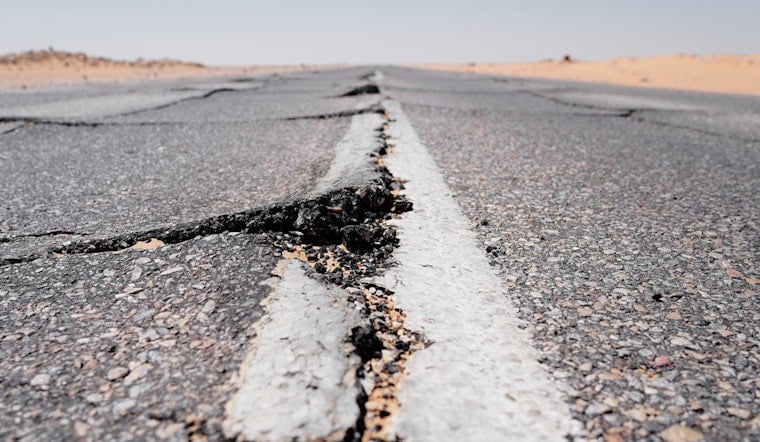
A new physics-based earthquake simulation is flashing a bright warning light at Southern California, and the bulb is blinking right over Cajon Pass. Researchers say tectonic stress along the southern San Andreas and San Jacinto faults is higher than at any point in their 1,000-year model, with the most intense loading concentrated near that critical junction northeast of Los Angeles. With stress on both faults lining up in the same place, scientists say the odds rise that a future rupture could jump from one fault system to the other, turning a big quake into a region-spanning one. The study stops short of naming a date, but the authors and local officials say the findings should sharpen retrofit and preparedness priorities across the Los Angeles area.
What the study did and why researchers care
The work comes from a 1,000-year earthquake-cycle model built by an international team led by Dr. Liliane Burkhard, which pieced together past ruptures using radiocarbon samples, tree-ring records and historical ground-rupture evidence, according to the University of Bern. The group ran four-dimensional simulations that follow how stress accumulates and shifts along the southern San Andreas and San Jacinto fault systems. In those runs, Cajon Pass emerges as the pivotal junction that largely decides whether a rupture stalls or keeps racing along both faults.
The numbers are jarring
In the new model, Coulomb stress climbs to about 3.6 megapascals on the San Jacinto-Bernardino section and around 2.8 MPa on the Mojave-South stretch of the southern San Andreas, the highest values anywhere in the 1,000-year simulation, according to the Journal of Geophysical Research. One megapascal equals roughly 145 pounds per square inch, which puts 3.6 MPa near 520 psi and 2.8 MPa around 406 psi. For comparison, most passenger car tires typically sit in the 30 to 35 psi range. For conversion figures and typical tire pressure ranges, see DigiCalc and AAA.
How Cajon Pass could "open the gate"
The team frames Cajon Pass as an "earthquake gate" that can either shut down a rupture or let it barrel through both fault systems. History backs up how much that matters. The massive 1857 Fort Tejon earthquake stopped its rupture near Cajon Pass, while the 1812 Wrightwood event appears to have kept going. In the new work, researchers say today’s unusually aligned stress on the two faults places Cajon Pass in the range that has previously lined up with through-going ruptures, a point underscored in the University of Bern summary of the study.
What this means for buildings and renters
Local rules have already zeroed in on some of the buildings most likely to suffer in a big shake. Los Angeles adopted a mandatory soft-story retrofit program in 2015 that targets older wood-frame structures with tuck-under parking, according to the Los Angeles Department of Building and Safety. West Hollywood followed with its own mandatory seismic retrofit ordinance in 2017 and maintains an open dataset, compliance roadmap and Tenant Habitability Plan requirements for covered properties, per the City of West Hollywood. Local coverage reports that more than 700 West Hollywood properties were initially flagged as potentially subject to the rules and notes that some owners may be able to recover part of their costs through rent adjustments or surcharges. Tenants and owners are urged to verify any cost-recovery options directly with city resources and program staff, according to WEHOonline.
Prepare and retrofit: grants, alerts and small steps
On the homeowner side, retrofit help is not just a nice idea but, in some places, a subsidized one. The California Residential Mitigation Program runs the Earthquake Brace + Bolt grant program, which can provide up to $3,000 toward eligible foundation and cripple-wall retrofits for qualifying houses, according to the California Residential Mitigation Program. For early warning, the USGS-backed ShakeAlert system can send smartphone alerts and trigger automated safety actions a few precious seconds before strong shaking arrives, as described by USGS ShakeAlert. None of these steps can stop a fault from breaking, but in combination with a basic household plan, they can significantly cut the risk when it does.
The study’s authors and their press teams are careful on one key point: this modeling is not a countdown clock. The simulation does not predict the exact timing of a major event, yet it does indicate that the fault system is critically stressed and that some possible rupture paths would have much broader impacts than others, according to the Journal of Geophysical Research. For people living in and around Los Angeles, that translates into a straightforward local message: control what you can. That means pushing soft-story retrofits forward, signing up for ShakeAlert notifications and checking on available grant programs now, while the ground is still quiet.





